Welcome to Day 3!
Today you’ll learn how to create your own blog easily. Blogging changed my life and made it possible to earn thousands of dollars per month doing work I enjoy. The good news is you can start a blog for just a few dollars each month. Below I explain affordable hosting options I’ve used and recommend, including a discounted offer with Bluehost that often includes a free domain for the first year. These promotions can change, so act promptly if you want to take advantage of a low price.
Click here to start a blog on WordPress, then follow the step-by-step tutorial below.
If you want an inexpensive WordPress blog, Bluehost is a solid hosting provider with a straightforward setup. I’ve had a positive experience using them.
If you plan to monetize your blog, build a freelance business, or grow it into something more professional, self-hosting through a provider like Bluehost is essential. Self-hosted WordPress lets you run ads, use affiliate links, and accept direct advertising without the limitations common to free blogging platforms. Free platforms like Blogger are harder to monetize and are often perceived as less professional by advertisers and companies.
In fact, if you review my past income reports, you’ll see my earnings grew significantly after switching to self-hosted WordPress—strong evidence that hosting matters for serious bloggers.
Here are some reasons I recommend Bluehost:
- Easy to use: Anyone can create a WordPress blog quickly with the steps below.
- Technical support: Bluehost provides customer support to help with hosting questions.
- Affordable: Bluehost’s plans are budget-friendly; hosting can start at a few dollars per month when you choose an introductory plan.
- Free domain: Many plans include a free domain for the first year.
- WordPress is free to install and use on Bluehost.
- Money-back guarantee: Bluehost offers refunds within a defined window if you decide it’s not right for you.
- Self-hosted benefits: Self-hosting gives you full control and a professional appearance to readers and potential partners.
To get started, go to Bluehost. Many bloggers choose them for hosting because they combine ease of use, support, and competitive pricing.
If you want to learn how to start a blog on WordPress using Bluehost, continue reading. If you sign up and need help with setup, plan selection, or any other question, feel free to email me—I’m happy to assist.
Click here to begin the process.
1. Register your domain name.
The first step in starting a WordPress blog on Bluehost is choosing your domain name. This can be a tough decision, so take time to pick something memorable.
I recommend a short, catchy name that’s easy to spell. Avoid long or confusing words that require constant explanation.
You can register a domain directly through Bluehost, which simplifies the setup. If you purchase at least 12 months of Bluehost hosting, you’ll often receive the domain free for the first year. Buying a year of hosting also typically reduces your monthly rate, making the free domain a nice bonus. If you claim the free domain, continue to the next step to purchase hosting and register the domain in one flow.
2. Buy hosting for your blog.
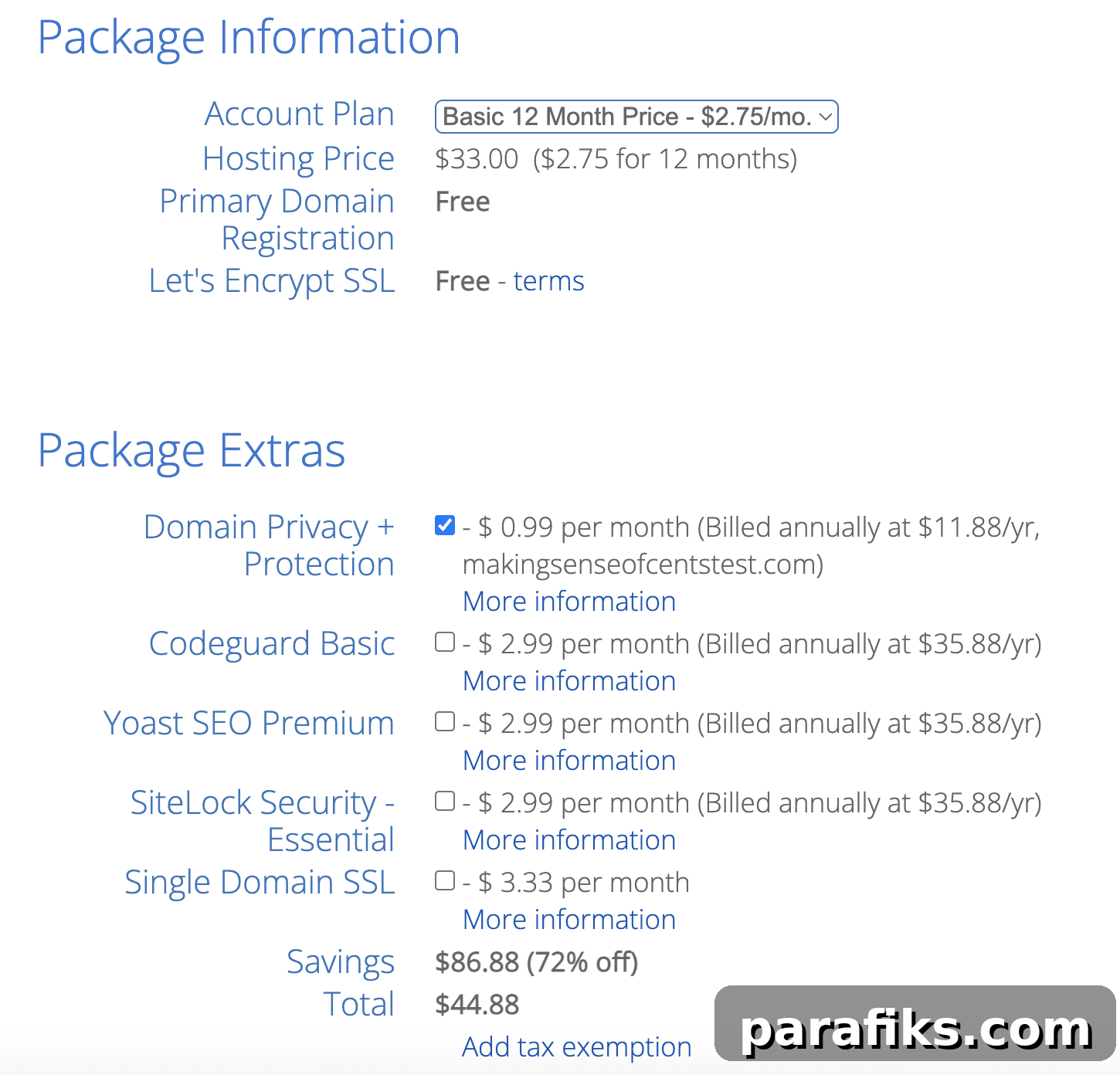
Setting up WordPress on Bluehost is simple. First, understand the typical costs involved:
- Choose the “Basic” plan for the cheapest, most appropriate option when starting out. Introductory pricing can be very low if you sign up for a 12-month plan, making your total annual cost quite affordable.
- The Basic plan is usually sufficient for a new blog. You can upgrade later if needed.
- Consider Domain Privacy Protection to keep your contact information private; it’s an optional add-on at a small additional cost.
- Uncheck extras you don’t need—many optional services are unnecessary for a beginner.
- Remember that many hosting promotions include a free domain when you buy at least 12 months of hosting.
I recommend committing to at least 12 months of hosting. Monthly billing can be more expensive, introduces the risk of accidental expiration, and typically costs more in the long run. Signing up for a year usually gives you a lower rate and the free domain. Bluehost offers refunds if you cancel within their refund period, so you’re not locked into a long-term penalty-free contract should you choose to stop.
Typical costs for hosting often fall around $59 per year on average for an entry-level plan, depending on promotions. Multi-year plans can reduce the average monthly cost even further.
When you’re ready to buy hosting, follow these steps:
- Go to Bluehost and click “Get Started Now.”
- Select the package you want (Basic is usually fine for beginners).
- Enter an existing domain you registered earlier or register a new domain during checkout.
- Provide your personal and payment information.
- Create a secure password for your account when prompted—store it safely.
3. Connect your domain and your hosting.
Note: If you register your domain through Bluehost, you can skip this section.
If your domain is registered with another provider, such as GoDaddy, you’ll need to point the domain to your Bluehost hosting by updating the domain’s nameservers. GoDaddy and other registrars provide support documentation for changing nameservers.
For GoDaddy, the nameservers should be set to:
- ns1.bluehost.com
- ns2.bluehost.com
General steps to update nameservers at your registrar:
- Log into your domain registrar account and go to domain management.
- Choose the domain you want to edit and locate the nameserver settings.
- Replace the existing nameservers with Bluehost’s nameservers (ns1.bluehost.com and ns2.bluehost.com) and save the changes.
After updating nameservers, add the domain as an add-on or assigned domain in your Bluehost hosting control panel. Log into Bluehost, go to the Domains section, and follow the prompts to assign or add your domain.
4. Install WordPress.
This is the exciting part: installing WordPress. Bluehost makes WordPress installation straightforward and free.
- Open your Bluehost control panel (cPanel); you’ll receive the login link in your welcome email.
- Find the MOJO Marketplace section and click the “One Click Install” option.
- Choose the WordPress icon under the Blogs section and click “Start.”
- Select the domain where you want WordPress installed from the dropdown menu.
- Under Advanced Options, set a secure username and password for your WordPress admin account. Avoid using “admin” as your username—choose a stronger, unique identifier instead. Leave the option to automatically create a new database checked unless you know you need another configuration.
- Click “Install Now” and wait for the installation to complete.
- Save your WordPress username and password in a secure place.
Congratulations — your WordPress blog is now live. From here you’ll want to work on design and start creating high-quality content.
Quick tips for navigating WordPress and growing your blog:
- Keep the WordPress login details email safe; it contains your unique admin URL, username, and password.
- Create posts from the “Posts” menu and pages from the “Pages” menu in the WordPress dashboard.
- Upload images via the “Media” section.
- Customize sidebars, footers, and other areas through “Appearance” → “Widgets.”
- For email newsletters, consider an email service designed for bloggers to build and manage your subscriber list.
- For themes and layout, the Genesis framework is a popular premium option, but WordPress also offers many free themes under “Appearance” → “Themes.” You can change themes anytime to find a look you like. If you prefer a quick premade design, many designers sell templates at affordable prices.
- Start an email list early—email remains one of the most effective ways to engage readers and promote your work.
If you’re not already enrolled in this free blogging course, you can sign up by visiting the free course page or by entering your details in the signup form on the original site.