
Today I’m sharing an inspiring debt payoff story from reader Samantha Brandon. This is how her family eliminated $70,000 in debt in seven months.
Like many, the pandemic forced us to pause and reassess our lives.
We were fortunate to have stable, well-paying jobs (I’m a pharmacist and my husband is a maintenance manager). We also bought a home at the end of 2019—just before the market jumped.
And yet, we were living paycheck to paycheck.
You might be wondering: how can people with six-figure combined incomes struggle this way?
The answer: daycare for two children, student loans, and miscellaneous debt while living in a sunbelt city where costs spiked.
No, we weren’t willing to uproot our lives and move to a cheaper city away from family and friends.
So there we were: good incomes, modest cars (a 15-year-old truck and a 7-year-old Nissan Murano), and a home well within our means—but still broke.
I believe in taking control of your future, so we made some bold decisions and got to work.
Related content:
- How I Retired At Age 30 with $500,000
- How This 34 Year Old Owns 7 Rental Homes
- How We Travel Full-Time On $1,400 Per Month
The Real Steps We Took to Pay Off Debt
1. We Devoted an Entire Day to Planning
We knew this would require uninterrupted time. With toddlers at home, we arranged for childcare and set aside six solid hours to face our finances.
What we brought to that day:
- Grateful in-laws to watch the kids for an afternoon
- A laptop with Google Sheets ready
- Two phones with access to all bank accounts
- My old calculator that I hadn’t used since high school
- Some beer to take the edge off when the numbers got real
There are many apps that automate budgeting, but doing this manually made a difference. Reading every purchase out loud forced accountability.
2. Creating a “Cost of Living” Spreadsheet
To determine true monthly costs, we reviewed all bank accounts and credit cards for the previous three months.
We built two sheets:
- The main “Cost of Living” sheet
- The “Spending Habits” sheet
First, we recorded fixed monthly costs on the Cost of Living sheet. Going line by line exposed bills that had changed, like insurance, and subscriptions we’d forgotten about. Those subscriptions were separated to cancel later.
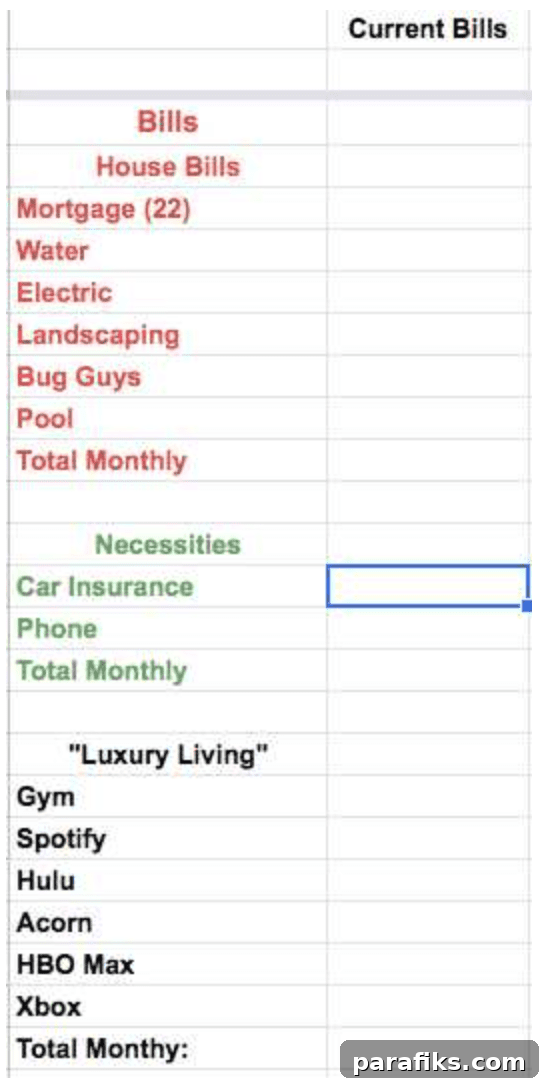
Next, on the Spending Habits sheet, we logged variable expenses—groceries, dining out, kids, home, medical, personal, gifts, and a miscellaneous category—by reviewing two bank accounts, a credit card, and our Amazon purchases over three months.

Seeing the actual purchases was eye-opening. We weren’t extravagant—no luxury cars or fine dining—but our spending still totaled $2,000–$3,000 per month on living expenses. Date nights with babysitters and rideshares added up quickly.
We averaged the three months’ spending to produce an accurate monthly figure.
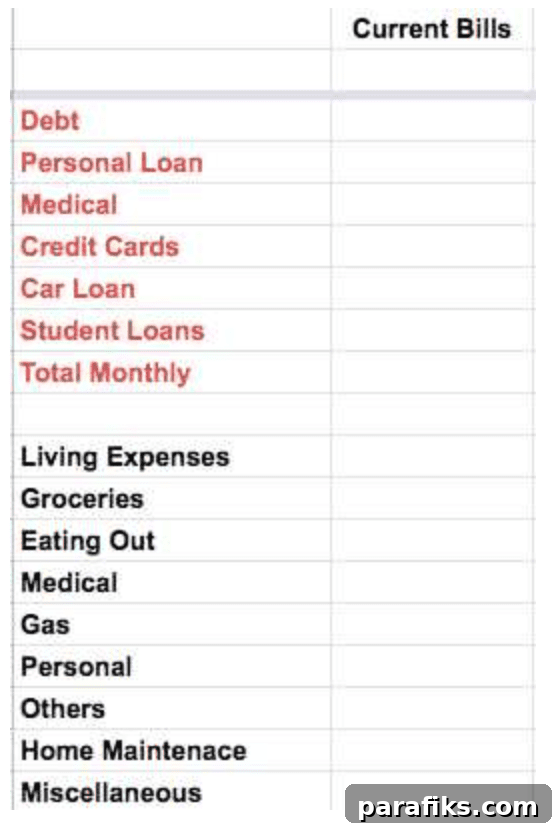
After a lunch break, we transferred those spending numbers into the Cost of Living sheet and added our debts (student loans, car loans, medical loans, etc.). Combining everything revealed what we truly needed to tackle.
3. Looking at the Final Picture
When the Cost of Living sheet was complete, the final tally showed no surplus—actually a negative balance of about $100 per month. We were spending more than we earned. That meant the status quo would never allow us to make real progress on our debts.
UPDATE: We originally forgot to include daycare as a necessity; it was $2,500 per month—an enormous cost that made a huge difference in our planning.
4. Add Up Your Total Debt
We listed every debt and its interest rate. Our balances were:
- Personal renovation loan: $40,000 (we bought a below-market home and renovated it ourselves—new floors, bathrooms, paint, irrigation—work that doubled the home’s value)
- Vehicles: $12,000 remaining on the Nissan Murano
- Credit cards: $18,000 (this fluctuated over time)
Total non-mortgage, non-student debt: about $70,000. The real wake-up call was realizing we were only making minimum payments and not reducing principal.
5. Create Multiple Debt Payoff Scenarios
With the Cost of Living spreadsheet in hand, we modeled different scenarios to see how long each would take to eliminate $70,000.
This step was crucial. Seeing timelines made it clear that the path we were on would leave us decades behind on savings and investments.
Options we considered:
Option 1: Live frugally
Cutting luxuries and tightening spending might save $1,000–$2,000 per month, but it would still take 4–5 years to pay off the debt—too long to live that way for us.
Option 2: Rent out our home and downsize
Renting the house and moving to a small apartment gave modest extra cash after storage and moving expenses—reducing payoff time to around three years—not ideal for our priorities.
Option 3: Move in with my parents
This reduced monthly costs significantly, but daycare remained a $2,500 monthly expense since my parents worked during the day, so payoff time was around two years.
Option 4: Move in with my in-laws
This option offered the largest monthly savings because my in-laws were retired and could help with childcare, eliminating the $2,500 daycare cost. The tradeoff was living over an hour from the city and our usual routines—but financially it was the most powerful choice.
6. We Chose to Move Out (Temporarily)
We decided to move in with my in-laws for one year to aggressively pay down debt, and then planned a year with my parents to reclaim some normalcy. An unexpected medical complication—an ongoing spinal CSF leak—extended our stay, but it also made living with family necessary for childcare and recovery.
I shifted to disability, reducing my paycheck by about 40%, but the rental market allowed us to rent our home and even turn a small profit, which helped offset lost income.
7. Living in the Middle of Nowhere: Surprising Savings
When we tallied expected savings from living with my in-laws, we counted:
- Daycare savings: $2,500 per month
- Reduced housing and bills: roughly $2,700 per month
We estimated debt payoff would take about a year. But living in a very small town produced additional unanticipated savings:
- Food budget dropped from about $2,000 to $1,000 per month
- No ongoing home improvement projects
- My in-laws initially covered internet, water, and electric while we focused on paying debt
- Weekends became low-cost social time in neighbors’ backyards rather than outings
Ultimately, we were able to direct nearly all monthly earnings toward debt.
8. Determining Debt Payoff Order
With both incomes saved and rental profit added, and living costs reduced to about $1,000 a month, we had flexibility in payoff strategy.
There are many methods: highest interest first is best mathematically, while the snowball method favors momentum by paying small balances first. For us, the right approach was practical:
We paid off the car first because it freed up a $650 monthly payment and could be eliminated in under two months. That freed cash flow to attack the large renovation loan next, and the credit cards last. This sequence maximized monthly cash available to aggressively pay principal on the largest balance.
9. What We Learned Paying Off $70,000 in Seven Months
Thanks to rental income and extra cash influxes like a bonus and tax refund, we eliminated $70,000 of debt in about seven months.
It wasn’t easy—leaving our home with children, long commutes for my husband, and exhausting weekend trips took a toll. But we gained far more than financial relief.
Living with grandparents gave our kids priceless time with them. We also spent more quality time as a family, had simple movie nights, and were far less tempted by outings.

Looking Forward
After paying everything off, our relationship with money changed. Here’s what we do differently now:
- Pay cash for big items: We don’t want car or furniture payments again. We’re saving to buy a used 10-year-old Prius in cash to reduce ongoing expenses.
- Be intentional with spending: We prioritize experiences like travel while preferring older vehicles and avoiding recurring debt.
- Maintain a healthy emergency fund: We now have six months of expenses saved, which brings peace of mind.
- Be ready to live on one income: With my health concerns, it’s critical we can manage on my husband’s income alone if necessary.
- Explore new ventures: Financial freedom allows us to consider starting businesses while being deliberate and frugal in startup costs.
- Invest for early retirement: We can now contribute to Roth IRAs, index funds, and consider real estate to work toward retiring earlier while still enjoying life now.
My Tips for Anyone Paying Off Debt
After this experience, here are some perspectives that might be unexpected but helpful:
- “Skip the Starbucks” advice isn’t always helpful. Small savings make a difference, but if you have large debt, eliminating caffeine won’t move the needle much and may make a plan unsustainable. Choose changes you can maintain long-term.
- Determine your true budget and model scenarios. When you see payoff timelines for different approaches, you can choose the one that fits your willingness to sacrifice and your goals. I’m an “all-or-nothing” person who prefers to pay things off fast; others may prefer steadier paths.
- It’s never too late. Start today. No one can pay down your debt for you.
- Create a future budget, not just a current one. Factor in upcoming expenses—kids’ activities, vacations, and rising costs—so you can plan proactively.
- Keep living. Don’t forgo joy while pursuing financial goals. Health and relationships matter. Make space for things that bring meaning even while you work toward financial freedom.
Author bio: Samantha Brandon is a pharmacist, a spinal CSF leaker, and a mother of two toddlers who is passionate about passive income and the FIRE movement.
Do you have debt? What are you doing to pay it off? Please share in the comments below.