
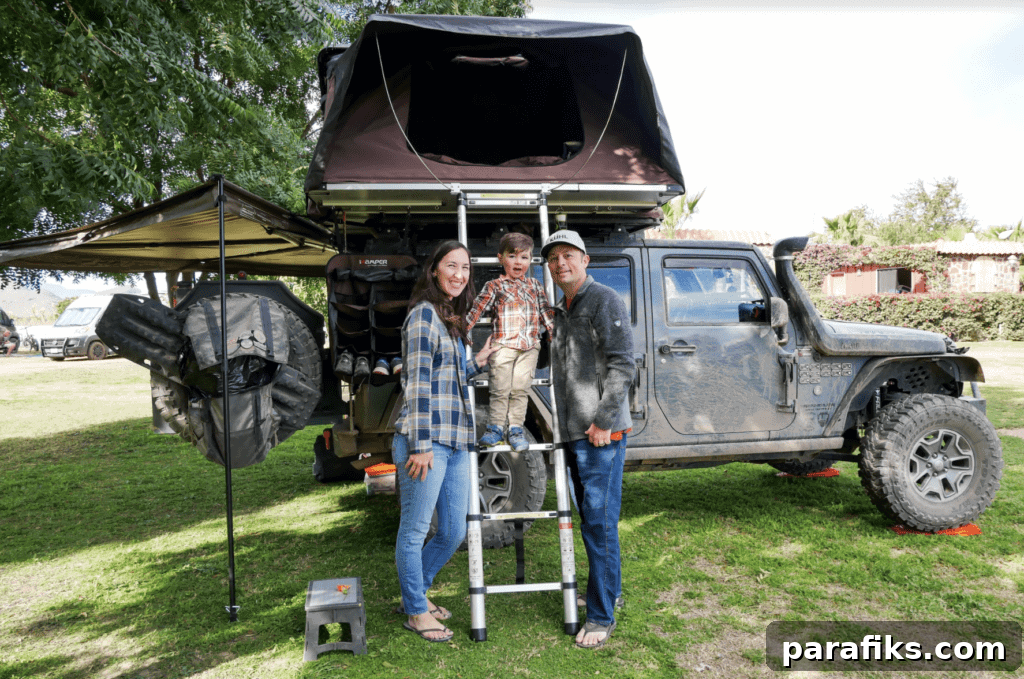
Next in my Extraordinary Series is Eric and Brittany from Hourless Life. This family does something different from most: they live and travel full-time in their Jeep with their young son.
Yes — they live full-time in a Jeep.
This overlanding family plans to drive across the world in their Jeep, visiting South America, Africa, Europe, and Asia. Their goal is to see as much of the globe as possible.
They’ve been full-time travelers since 2014, starting out in an RV, and have stayed on the road ever since. Now they are preparing to travel the world in a Jeep Gladiator truck.
In this interview you’ll learn:
- How they live in a Jeep with their son
- How they afford to travel
- What overlanding means
- Where they sleep, cook, and use the bathroom
- What an average day living in a Jeep looks like
- How much overlanding around the world will cost
- Their tips for traveling with a child
This article is useful whether you’re curious about family overlanding or considering RV life—both are valid options depending on your goals.
Find Hourless Life on Instagram.
Please enjoy this interview — I learned a lot and I think you will too.
Related articles you may be interested in:
- How This Couple Does Van Life with A Baby (and a dog!)
- 11 Reasons to Choose RV Life
- How To Make Money While RVing
- How Much Does It Cost To RV?
- Full-Time RV Travel With 3 Kids
How this family lives and travels the world in their Jeep
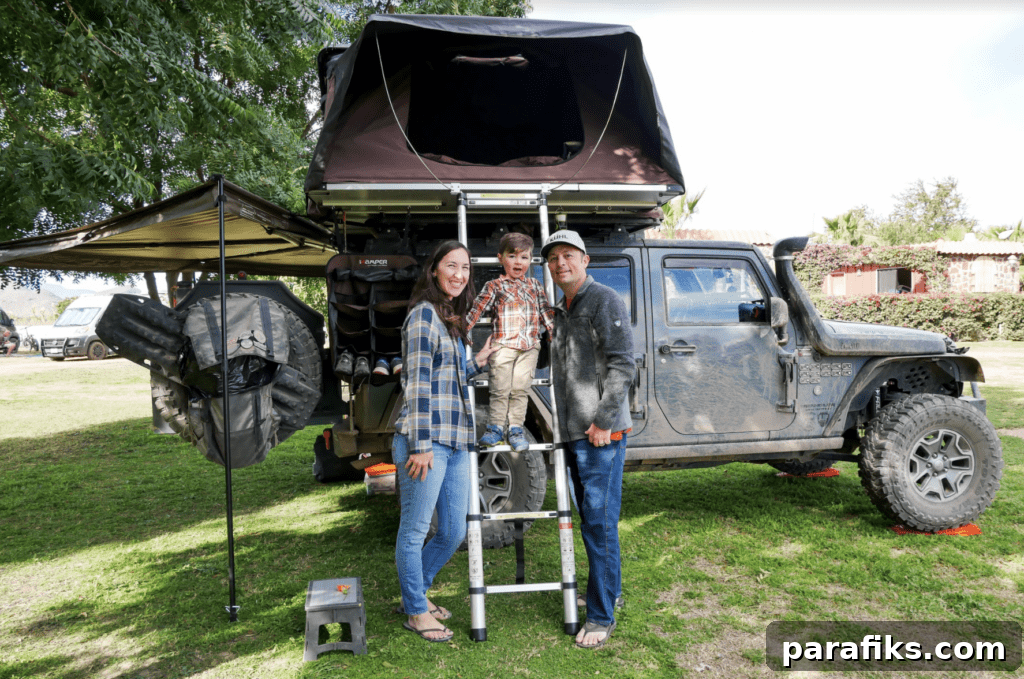
1. Tell me your story. Who are you and what do you do?
We are Eric (50), Brittany (33), and our son Caspian (4) Highland. Our travel brand is Hourless Life. We began full-time travel in February 2014 and have been living on the road since then. Using internet access and careful planning, we were able to take our first small business with us to support our travels.
We started in a 40-foot Tiffin Phaeton RV that was ten years old when we bought it. We paid cash to avoid monthly loan payments. Although it felt small at first compared to our two-bedroom apartment in Austin, the RV eventually felt spacious.
We sold the Tiffin in December 2018 and moved into our Jeep Wrangler, attracted by the idea of international overlanding. To test the lifestyle, we took our Jeep 2,000 miles through interior Mexico in early 2019, which confirmed that international overlanding would be our next big adventure.
Since then we’ve worked toward driving around the world. We bought a 2016 Winnebago View for U.S. travel and loved it, but sold it in March 2021 to fund the build-out of our global vehicle — a Jeep Gladiator. Right now we live in our Jeep Wrangler and are traveling throughout the Southwest.
2. How do you afford to travel? Do you work online?
Our finances have changed dramatically over the past decade. Eric retired from the military in 2010 after 20 years and receives a pension. After leaving the service, we worked for others before launching a boutique online marketing agency in January 2011. Growth was slow at first, but we gradually built more income streams.
In 2012 we moved from Seattle to Austin and pushed into full-time self-employment. We set short-term income goals, hustled for clients and side gigs, and after six months we realized we could sustain our business.
Over the years we launched several projects: a city blog, a Jeep club with memberships and products, and travel blogs related to RVs and off-roading. Client work from our marketing agency remained the primary income source, but we diversified to create financial stability.
By late 2019 we made major decisions. We knew internet access outside the U.S. would be unreliable for demanding, scheduled work, so we began simplifying. We sold the Austin blog, handed off the Jeep club, outsourced daily tasks for the agency, and combined our travel blogs into Hourless Life.
Hourless Life now supports our family through affiliate partnerships, advertising, community donations, and a YouTube channel Eric is focusing on. Combined with Eric’s military income, these pieces allow us to travel sustainably while pursuing our dream of global overlanding.
3. What is overlanding?
Overlanding is self-reliant, vehicle-based adventure travel, typically over long distances and often crossing international borders. It emphasizes the journey, not just getting quickly from point A to point B. Overlanding is more of a lifestyle than a specific vehicle type, which makes it harder to define precisely. In short, it’s travel focused on exploration, self-sufficiency, and the experience along the way.
4. Why did you decide to start overlanding with a family?
Our wanderlust kept growing. After years of RV life and the birth of Caspian in 2016, the RV lifestyle began to feel comfortable but no longer challenging. Listening to stories of families driving around the world inspired us — in particular the Snaith family, who traveled extensively with their children.
Hearing what others accomplished made us realize we could pursue international overlanding as a family. That inspiration convinced us to aim to drive around the world.
5. Tell me about where you live. What vehicle will you use and where will everyone sleep?
We began with a 2014 Jeep Wrangler Rubicon for off-roading and overlanding experiments. After successful trips in interior Mexico and down the Baja Peninsula, we moved into the Wrangler full-time in March 2021.
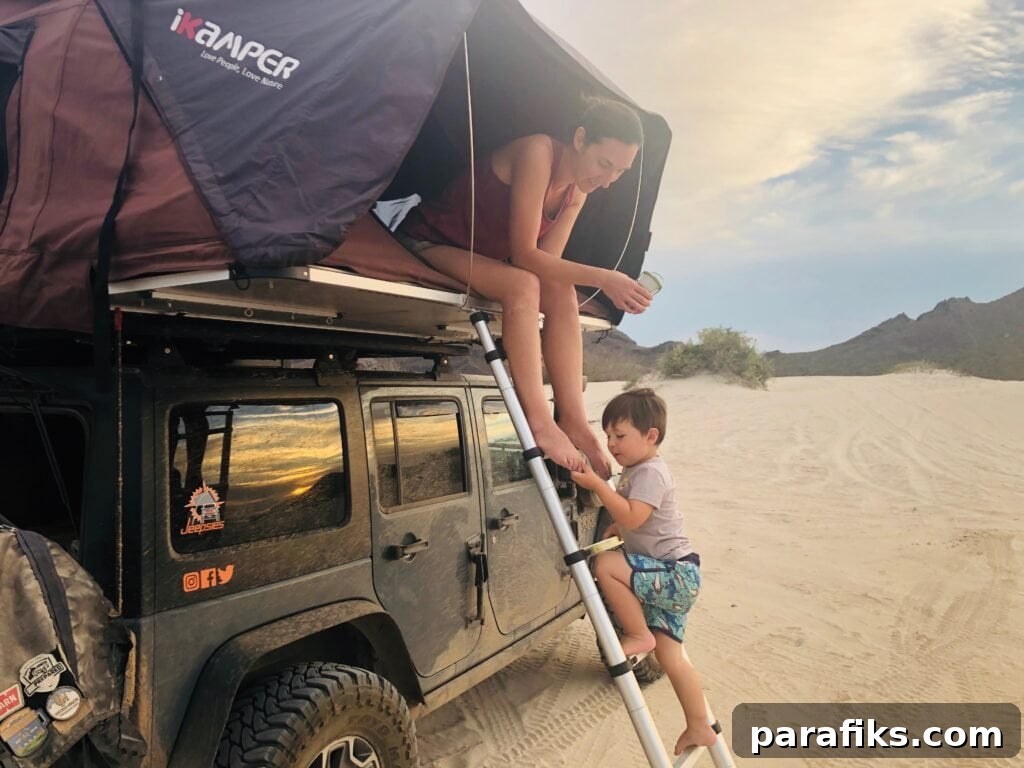
Starting in June 2021 we planned to build our global vehicle: a 2021 Jeep Gladiator Sport S with the Max Tow Package for maximum payload capacity. The Gladiator’s truck bed will house an Alu-Cab Canopy Camper made in South Africa, with a rear entry door. Eric and I will sleep in a pop-up tent on top of the canopy.
The lower bed area will be fitted with Goose Gear cabinet storage and sleep deck plates that create a platform for our son. Initially, one deck plate will suit Caspian; as he grows we’ll add more plates for extra sleeping space. In later years he may prefer a ground tent or a hammock, options commonly used by long-term overlanders.
6. Where do you hope to travel?
We aim to drive across all six habitable continents. By September 2021 we hoped to spend six months in interior Mexico, then use visa lengths to plan routes through Central and South America beginning around February 2022. From South America we plan to ship the Gladiator to South Africa, travel up the eastern side of Africa, explore Europe, and continue across Asia.
We expect to ship the Gladiator back to the United States at some point. Australia’s strict import rules make buying a vehicle locally there a more practical option for that leg of travel.
7. How do you handle bathrooms, showers, and meals?
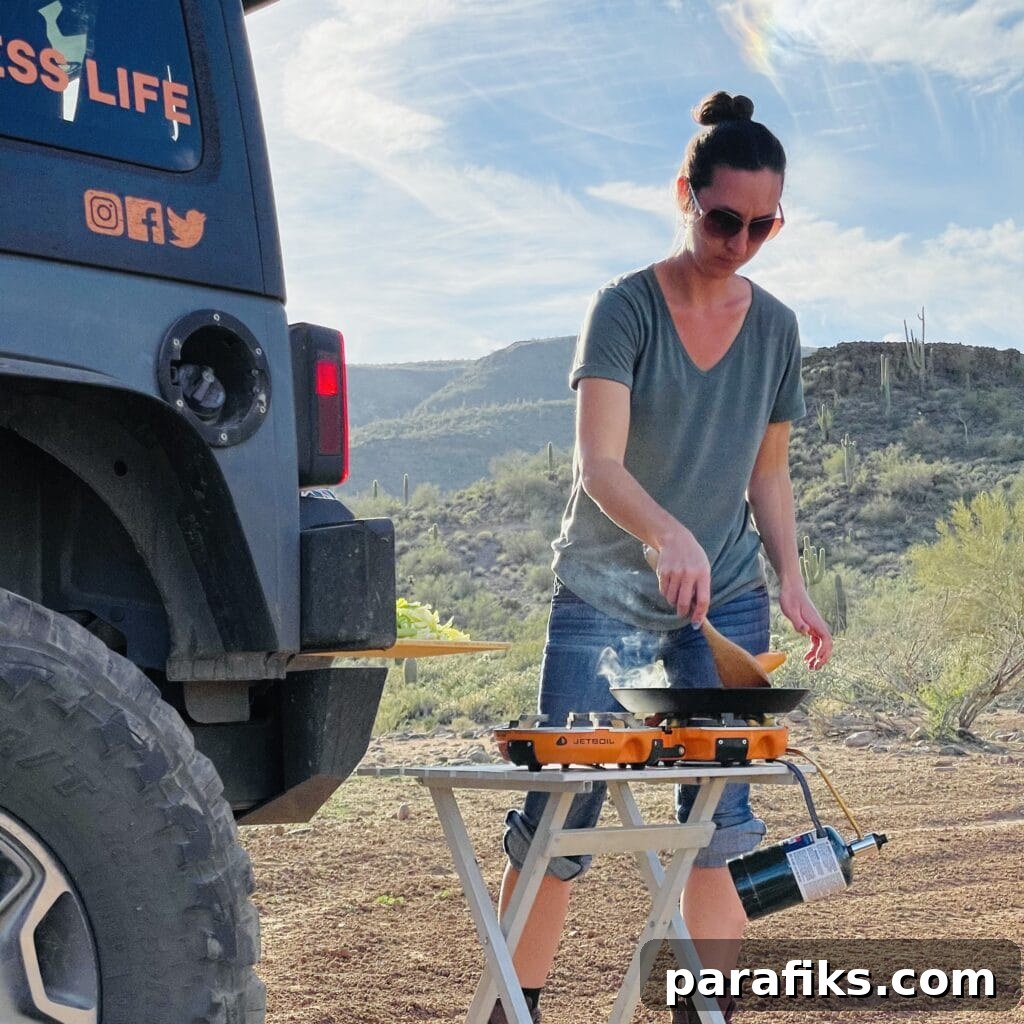
We use three bathroom options: a hole-and-shovel method when off-grid, a portable Thunderbox toilet when privacy is needed, and public restrooms at state parks or other facilities. We don’t carry a dedicated shower; instead we use campground showers, friends’ houses, gyms, truck stops, or occasionally book an Airbnb just to use a clean bathroom.
Our kitchen is minimalist but functional: a two-burner Jetboil stove, an ARB fridge, standard pans, pots, and utensils. We usually grocery shop every three to four days and have managed to fit a week’s food into our fridge when necessary. We rarely go hungry and keep meals simple to match life on the road.
8. What’s an average day like living in a vehicle?
Our daily rhythm is changing as we transition from the Wrangler into the Gladiator build and prepare for Mexico. Currently we wake around 6 a.m. I often get quiet time downstairs to work and have coffee before Caspian rises around 7 a.m. Mornings are leisurely: breakfast, cleanup, and pack-up, often leaving camp by 9 a.m.
Some days we travel to a new campsite and explore local sights; other days we find a coffee shop and catch up on work. Eric edits YouTube videos while I work on freelance writing. Caspian enjoys parks, playgrounds, and local treats.
We rarely drive more than 100–150 miles in a day to leave time for exploring. Dinner is usually by 5 p.m., and Caspian is in bed by 7 p.m. Evenings may include conversation by the campfire, reading, or finishing work.
9. How much will overlanding around the world cost?
Our current daily budget for full-time overlanding in the U.S. is $93, covering fuel, food, camping, and supplies. Vehicle insurance, life insurance, and subscription services are not included. We expect this budget to stretch further outside the U.S., where camping and food are often cheaper.
The advantage of vehicle-based travel is flexibility: stay longer in a place you like to save on fuel, use free camping when possible, and cook rather than eat out. We plan to grow our YouTube channel and writing income for extra cushioning and to fund more activities.
10. How is traveling with a child? Any tips?
Traveling with a child is incredibly rewarding. Caspian was born into travel and never had to adjust to a different lifestyle, so he’s remarkably flexible and comfortable with long drives, hikes, and new environments.
If you want to travel with your kids, start small and build endurance over time: short hikes, short drives, and activities that match their interests. When Caspian was born we set a goal for him to hike one mile for each year of life; by age four he was hiking four miles. Incremental challenges build stamina and confidence for the whole family.
11. Best tips for someone who wants to start overlanding?
Start with what you have and just go. Avoid getting trapped by gear marketing and social media pressure — you don’t need everything to enjoy your first trip. Learn by doing, refine your setup over time, and connect with an active overlanding community. Events like Overland Expo and regional rallies offer classes and a chance to learn from experienced travelers. Take your dreams seriously — life is short. Happy trails!
Are you interested in overlanding and driving around the world?