
Do you want to reach financial independence and have the option to retire early? This interview with Cody Berman, an entrepreneur, real estate investor, and personal finance expert who reached financial independence at 25, lays out a clear, practical path that doesn’t rely on luck or waiting decades to build wealth.
Cody’s approach focused on rapidly increasing income, maintaining low living costs, and investing consistently. Over a few intense years he grew his net worth to over $1,000,000, acquired multiple income streams, and created a life where work is optional. Since then, he’s helped thousands learn to take control of their time and money and recently published a book offering a step-by-step plan to reach financial independence faster than most expect.
This interview covers how Cody did it: how he boosted income, controlled expenses, and built both stock market and real estate portfolios. He also answers common questions such as how to calculate your financial independence number, realistic side hustles to start today, investing strategies for early retirement, and what life looks like after reaching FI.
How I Reached Financial Independence at 25 With a $1,000,000 Net Worth
If you’ve wondered whether early retirement or more flexibility is possible for you, this interview contains practical tips and real-world tactics that worked for Cody and for many people he’s helped.
1. Tell us your story: who are you and how did you reach financial independence so quickly?
My name is Cody Berman. I discovered financial independence after reading books and blogs that challenged the traditional career path. I started with an $80k finance job out of college but found the commute, long hours, and unhappy work environment intolerable. While still working, I built side hustles during commutes and evenings. After seven months I’d saved $35,000 and earned about $1,200/month from side projects, which gave me the confidence to go full-time into entrepreneurship.
Over the next three years I focused on scaling side businesses, keeping expenses low, and investing aggressively. By the end of year three I had over $500,000 in the market, 11 rental properties, and a profitable digital products business. The concentrated effort was intense but transformative.
2. What did your income, savings rate, and net worth look like during those years?
Income rose quickly while expenses stayed nearly the same, which created extremely high savings rates.
Year one: earned $96,000, spent $24,000 (75% savings rate), net worth around $179,000.
Year two: earned $198,000, spent $24,000 (88% savings rate), net worth about $392,000.
Year three: earned $403,000, spent $24,000 (94% savings rate), net worth crossed $1,035,000.
The lesson: widening the gap between earnings and spending is the core driver of fast financial progress. Investing that difference over time compounds into real freedom.
3. What do terms like FI, FIRE, and early retirement mean?
FI (Financial Independence) means your investments and passive income cover your lifestyle, so you no longer must work for money. FIRE (Financial Independence, Retire Early) adds the choice to step away from work completely. Early retirement isn’t an age—it’s a number: when your assets cover your expenses, you can retire whenever that happens.
4. Does financial independence require fully stopping work?
No. FI looks different for everyone. Common approaches include mini-retirements, Coast FI (invested enough to let money grow without aggressive saving), Barista FI (part-time low-stress work plus investments), Lean FI (covers a minimal lifestyle), Cash Flow FI (income-producing assets cover expenses), Traditional FI (investments fully cover lifestyle, often using the 25x rule), and Fat FI (ample margin for a comfortable life). Choose the style that fits your priorities.

5. What does day-to-day life look like now that you’re financially independent?
Being FI doesn’t mean doing nothing. I still enjoy building things. A typical day (8–9 months a year) includes morning exercise, language practice, focused work blocks, walks, and evenings with friends. For a few months a year we travel and work very little. I work in “seasons”: sometimes intense focus, sometimes near-zero work. The optionality makes work more meaningful.
6. How did you keep expenses under $2,000/month early on?
By optimizing the Big 3: housing, transportation, and food. We house-hacked a multifamily property so rent covered much of our housing costs, kept a paid-off reliable truck instead of taking car payments, and spent intentionally on food—still dining out but with moderation. These categories account for most spending for the average household, so improvements there move the needle significantly. Today we spend more on travel and experiences but remain intentional.
7. How did your income grow from about $96K to over $400K?
The shift came from moving to scalable income sources rather than trading hours for dollars. I scaled a digital products business, bought rental properties, and built a personal finance brand that earned through content and affiliates. Scalable assets—digital products, real estate, and content—let income compound instead of stopping when I stopped working.
8. Realistic side hustles to start today
Think in categories rather than one “best” hustle:
– Trading Time for Money: gig work, freelancing, VA work—quick cash but limited scaling.
– Scalable Side Hustles: digital products, rental real estate, affiliate income—upfront work that can pay repeatedly.
– Sharing Economy: rent out assets like rooms or cars for passive income.
– Hybrid Hustles: start with service work and transition to products or assets (e.g., a freelancer selling templates or a coach building a course).
Pick what fits your skills and preferences, test, and scale what works.
9. How do you calculate how much money you need to retire?
First, calculate your monthly spending from bank and credit card statements. Two main approaches follow:
– Nest Egg Method: Multiply annual expenses by 25 (the 25x rule). For $50,000/year spending, target roughly $1.25 million invested.
– Cash Flow Method: Build income streams that produce monthly income equal to expenses ($4,167/month for $50,000/year). This can come from rentals, businesses, or digital products and doesn’t rely on selling investments.
Many people use a mix of both strategies.
10. Is health insurance a big concern for early retirees?
Health insurance is manageable and varies by location and family needs. When I left my job, I found a high-deductible plan for a reasonable monthly premium. Today our shared plan costs more, but it’s a known expense. Use your state exchange or Healthcare.gov to get real quotes and incorporate that number into your FI plan—there’s nothing mystical about it.
11. Advice for someone with little or no savings who feels behind
Focus on creating a gap between income and expenses. If you earn a lot but still live paycheck to paycheck, trim the Big 3: housing, transportation, and food. If expenses are already tight, prioritize increasing income via side hustles, job changes, or negotiation. Once you consistently save and invest that gap, compound growth does the rest.

12. What is your investing strategy and how simple can it be?
Most of my money was split between the stock market and real estate. For stocks I used broad total market index funds to capture market returns without trying to pick winners. I automated contributions—retirement accounts and recurring investments—so it happens without thinking. For real estate, I bought long-term rentals in markets that met simple criteria (e.g., the 1% rule) and expanded my search until numbers made sense. Keep investing simple: pick a sensible plan, automate, and stay consistent.
13. Recommended budgeting tools, calculators, or apps
You don’t need complicated tools—understanding income, expenses, and the gap between them matters most. Simple options that help include budgeting apps like YNAB or Monarch, spreadsheets, and net worth trackers that consolidate accounts. Use a compound interest calculator to visualize long-term growth. The best tool is the one you’ll actually use consistently.
14. Step-by-step plan to start working toward early retirement
Start simple and follow this order:
1. Figure out how much you’re spending by averaging bank and credit card statements.
2. Calculate your FI number (annual expenses x 25 is a simple rule of thumb).
3. Optimize the Big 3: housing, transportation, and food.
4. Increase your income through raises, job changes, or side hustles.
5. Build an emergency fund and pay off high-interest debt.
6. Start investing consistently in tax-advantaged accounts and low-cost index funds, and automate contributions.
Repeat: track your numbers, widen the gap between income and expenses, and invest the difference. That gap is what accelerates your path to FI.
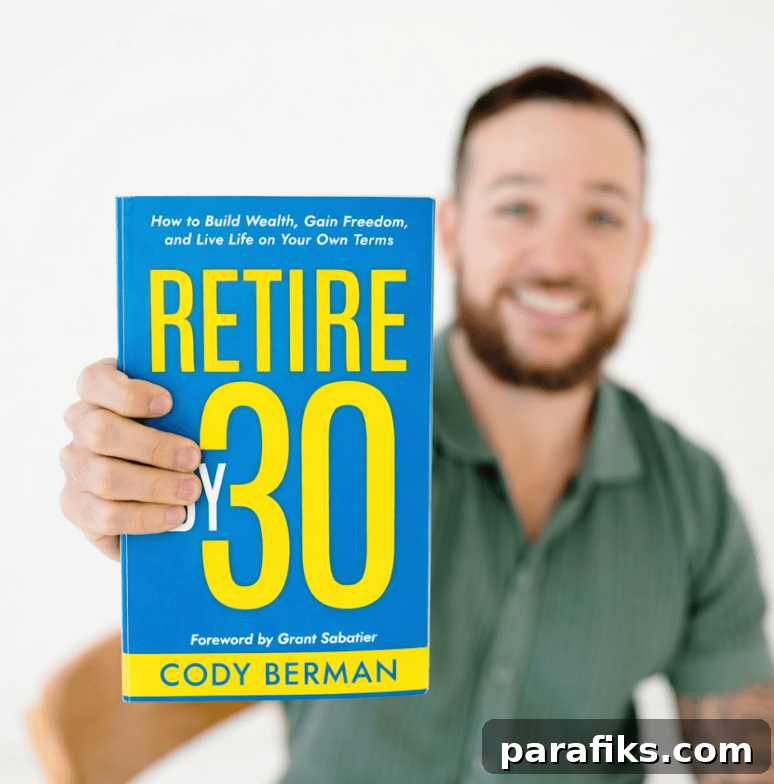
15. About the book Retire By 30
Retire By 30 is a practical, step-by-step guide to achieving financial independence without unnecessary complexity. It’s organized into five sections: The Basics (what FI is and why the income/expense gap matters), Expenses (tracking spending, managing debt, optimizing the Big 3), Income (side hustles, career growth, networking), Investing (stocks, real estate, alternatives, and taxes), and Early Retirement (withdrawal strategies and what life after FI looks like).
The book includes real case studies from people who reached FI in a decade or less, offering multiple paths rather than a single rigid template. It aims to give readers a clear, actionable plan based on real examples and straightforward principles.
What are your thoughts on early retirement? Would you want to reach financial independence?
Recommended further reading on different FI journeys and strategies is available from many real-life case studies. If you want to build freedom faster, focus on the gap between what you earn and what you spend, invest consistently, and pursue scalable income where it fits your skills and risk tolerance.