
This article was produced in partnership with The Entrust Group.
Having more options for your retirement savings is valuable. Self-directed IRAs (SDIRAs) expand what you can hold in a tax-advantaged retirement account, allowing investments in real estate, private companies, precious metals, cryptocurrencies, and other alternative assets. Unlike a traditional IRA or 401(k) at a brokerage—where choices are typically limited to stocks, bonds, and mutual funds—an SDIRA gives you direct control over investment decisions while preserving standard IRA tax benefits.
Key Takeaways
- Self-directed IRAs let you diversify with alternative assets not commonly available in standard retirement accounts.
- SDIRAs can be set up as traditional or Roth accounts, each with different tax implications.
- SDIRAs require greater due diligence, carry unique risks (including fraud and illiquidity), and often involve higher fees.
What is a Self-Directed IRA? – Complete Guide
A self-directed IRA is an individual retirement account recognized by the IRS that simply gives you broader investment options. The primary distinction is that an SDIRA permits direct investment in alternative assets—such as real estate, gold, private equity, and certain cryptocurrencies—while still offering the tax advantages of a standard IRA.
With an SDIRA, every investment and transaction is initiated by you, not by a brokerage selecting a menu of public securities on your behalf. That control opens new possibilities but also shifts more responsibility to the account holder.
Why haven’t I heard of a self-directed IRA?
SDIRAs are less common than typical brokerage IRAs because they require more active involvement and specialized administration. Many investors prefer the simplicity of stock and bond investing through a brokerage, while SDIRAs are better suited for those who want to leverage specific expertise—such as real estate investing or backing startups—or who want to diversify into assets outside public markets.
How is a self-directed IRA different from a regular IRA?
The main difference lies in the range of permissible investments. Standard IRAs are typically limited to publicly traded securities: stocks, bonds, ETFs, and mutual funds. SDIRAs, by contrast, allow alternative investments like rental properties, private company equity, physical precious metals, and select digital assets. If diversification into these asset classes fits your strategy, an SDIRA can be a powerful tool.
Types of self-directed IRAs
SDIRAs offer the same tax-advantaged structures as traditional IRAs. The two main types are:
- Traditional self-directed IRA – Contributions are typically made with pre-tax dollars, which can lower taxable income today. Withdrawals during retirement are taxed as ordinary income.
- Roth self-directed IRA – Contributions are made with after-tax dollars, so qualified withdrawals in retirement (including investment gains) are tax-free.
Your choice should reflect your current tax situation, retirement timeline, and whether you expect to benefit more from tax-deferred growth or tax-free withdrawals. Also keep annual contribution limits and income rules in mind, as these change periodically.
How does a self-directed IRA work?
To use an SDIRA, open an account with a custodian or administrator that supports self-directed accounts. You can fund the SDIRA by rolling over an existing 401(k), transferring an IRA, or making new contributions. The custodian handles recordkeeping and transactions but does not provide investment advice or choose investments for you—those decisions are your responsibility.
You must follow IRS rules for SDIRAs, including prohibited transaction rules and contribution limits. Because alternative assets often have different holding, reporting, and liquidity characteristics, thorough research and careful recordkeeping are essential.
What Can You Invest In With A Self-Directed IRA?
SDIRAs permit many asset classes that conventional IRAs typically do not. Common choices include:
Common investment choices
- Real estate – Residential or commercial rental properties, land, and income-producing assets.
- Precious metals – Physical gold, silver, platinum, and palladium held in approved forms.
- Private equity – Shares in private companies, startups, and small businesses not listed on public exchanges.
- Cryptocurrencies – Certain custodians permit digital currencies like Bitcoin and Ethereum in an SDIRA.
- Commodities and energy – Investments in oil, gas, renewables, and related projects.
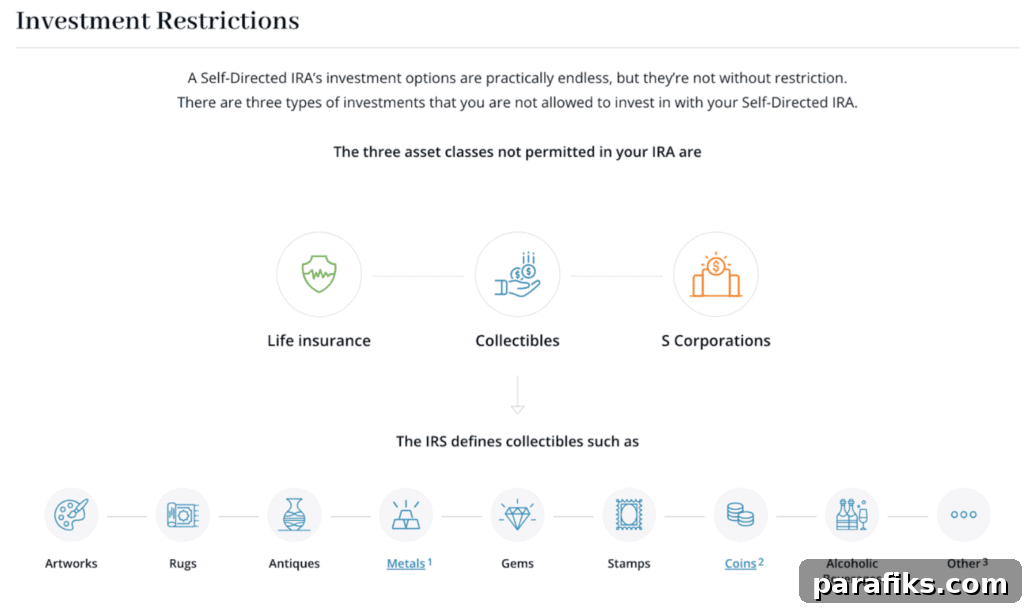
Prohibited investments in self-directed IRAs
Even with broad flexibility, SDIRAs have restrictions. Examples of prohibited investments include:
- Collectibles – Items such as antiques, artwork, and most coins or stamps are generally disallowed.
- Life insurance – Life insurance contracts are prohibited holdings in IRAs.
- S corporations – IRAs cannot hold stock in S corporation entities.
Understanding a Self-Directed IRA (SDIRA)
Key considerations when evaluating an SDIRA include due diligence, legal compliance, costs, and liquidity constraints.
Due diligence
Because you direct all investments, thorough research is critical. Evaluate counterparties, market conditions, valuation methods, exit strategies, and any specific risks tied to the asset class before committing retirement funds.
Legalities and regulations
IRS rules govern what an SDIRA can and cannot do, including restrictions on prohibited transactions and dealings with disqualified persons (for example, close family members). Violating these rules can trigger taxes and penalties. Certain assets may require additional reporting and compliance steps.
Fees and expenses
SDIRAs generally incur higher administrative fees than standard brokerage IRAs. Typical charges include account setup fees, annual recordkeeping fees, transaction or asset-setup fees, and special reporting costs. These fees can affect net returns, so factor them into your investment analysis.
Contribution limits and rules
SDIRAs follow the same annual contribution limits and distribution rules as other IRAs. Keep current on annual limits, catch-up provisions if applicable, and rules for rollovers or transfers to avoid unintended tax consequences.
Withdrawal rules and penalties
Early distributions from an SDIRA generally incur the same penalties as other IRAs: withdrawals before age 59½ may face a 10% early withdrawal penalty plus income tax on taxable distributions (for traditional IRAs). Roth SDIRA qualified withdrawals are tax-free if rules are met.
Pros and cons of a self-directed IRA
Advantages
- Diversification – Access to real estate, private equity, precious metals, and other non-traditional assets.
- Tax benefits – SDIRAs retain the tax advantages of traditional or Roth IRAs, depending on the account type.
- Potential for higher returns – Alternative assets can offer outsized returns compared with public markets, though they often come with more risk.
Disadvantages
- Complexity – Greater administrative and compliance responsibilities fall on the investor.
- Higher risk and lower liquidity – Alternative investments can be illiquid, harder to value, and less regulated, increasing the potential for loss or fraud.
- Fees – Administrative and transaction fees for SDIRAs are often higher than for standard IRAs.
How to Open a Self-Directed IRA
Opening an SDIRA typically involves these steps:
- Choose an SDIRA custodian or administrator that supports the asset types you plan to hold.
- Confirm the custodian’s policies—some do not allow single-member LLCs, certain cryptocurrencies, or specific asset classes.
- Select a traditional or Roth SDIRA based on your tax strategy.
- Establish the account and pay any setup fees.
- Fund the SDIRA by transfer, rollover, or contribution and begin sourcing eligible investments.
Working with an experienced financial or tax advisor can help you navigate complex IRS rules and ensure your investments and transactions remain compliant.
The Entrust Group Review
The Entrust Group is a long-established SDIRA administrator with decades of experience, tens of thousands of clients, and billions in assets under custody. They support a variety of funding methods—rollovers, transfers, and contributions—and provide transparent fee schedules for account setup, annual recordkeeping, transaction handling, and asset purchases or sales.
Fees vary depending on account size and the number of assets. For example, smaller accounts with a single asset may incur a modest setup fee plus an annual recordkeeping fee, while larger or multi-asset accounts face higher recordkeeping costs. The Entrust Group provides tools to estimate fees so you can model expected expenses before opening an account.
As a reputable provider, The Entrust Group can simplify administrative tasks and compliance, making it easier to pursue diversified retirement strategies with alternative assets.
Frequently Asked Questions About Self-Directed IRAs
Here are concise answers to common questions about SDIRAs.
What are the risks of a self-directed IRA?
Risks include potential fraud, higher fees, illiquidity, valuation challenges, and the need for extensive due diligence. Because you control investments, mistakes or prohibited transactions can generate significant tax penalties.
Do you pay taxes on a self-directed IRA?
Taxes depend on the account type. Traditional SDIRAs offer tax-deferred growth and are taxed on distributions; Roth SDIRAs use after-tax contributions and permit qualified tax-free withdrawals.
Is a self-directed IRA better than a 401(k)?
“Better” depends on your situation. A 401(k) may offer employer matching and simplicity, while an SDIRA offers broader investment choices and greater control. Many investors use both to balance convenience, diversification, and tax planning.
How do self-directed IRA fees work?
SDIRAs typically include setup fees, annual maintenance or recordkeeping fees, and transaction-related fees. These costs reflect the additional administration required for alternative assets and should be weighed against potential returns.
Can I invest in real estate with a Self-Directed Roth IRA?
Yes. You can purchase rental properties, raw land, or other real estate within a Self-Directed Roth IRA, subject to IRS rules and custodian policies. All income and gains in a Roth SDIRA can be tax-free on qualified withdrawals.
Are Self-Directed IRAs a Good Idea? – Summary
SDIRAs are a powerful option for investors who want to diversify beyond public securities and who are prepared to take on the research, compliance, and administrative responsibilities involved. They can offer attractive tax treatment and access to alternative assets, but they also bring higher fees, complexity, and specific risks. If you have expertise in a particular asset class or want greater control over retirement investments, an SDIRA may be a suitable choice—ideally with guidance from experienced custodians and financial advisors.
If you’re considering opening a self-directed IRA, The Entrust Group offers consultations with IRA specialists to help evaluate whether an SDIRA fits your retirement goals.