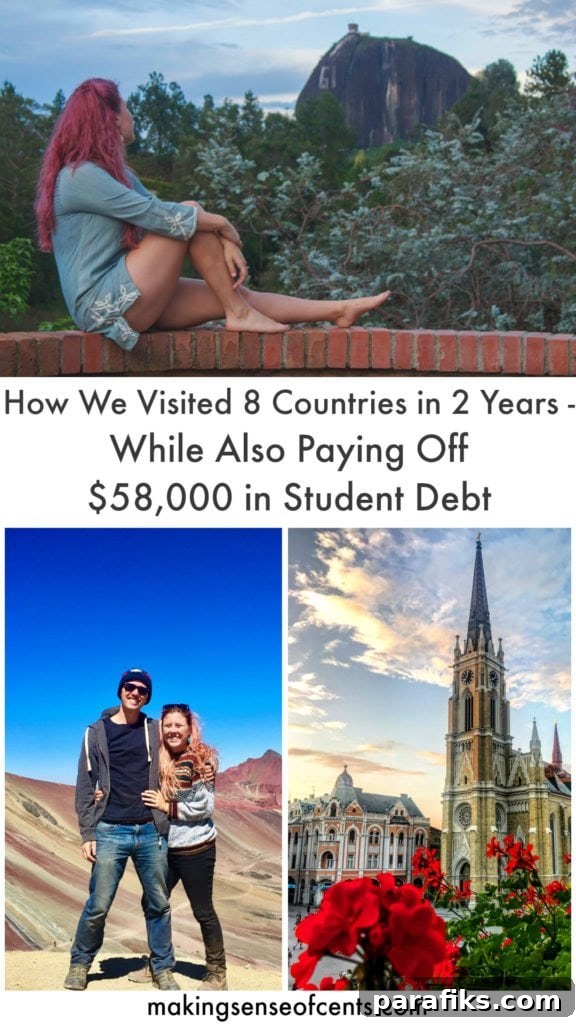
 A reader recently reached out to share how she and her husband paid off about $58,000 in student loans in two years while traveling the world. Below is their story and the exact steps they followed.
I always knew I wanted to travel. Watching my older sister go abroad when I was a child planted the seed, and I never lost the desire to see the world.
Still, I wasn’t sure how it would actually happen. As graduation from Boston College approached in 2014, I felt adrift—no clear career path and $58,000 in student loans between my future husband and me. Despite that, all we wanted to do was travel.
So how did we combine our dream of international travel with the reality of substantial student loan debt? Below are the practical steps we took to make it happen, followed by tips for anyone who wants to follow a similar path.
Related content:
- From Backpacker Working For $3 An Hour To Sailor With An Online Business
- The Digital Nomad Lifestyle – A Day In The Life
- Here’s How To Save Thousands For Your Next Vacation
- How I’ve Paid Off $29,000 In Debt By Living In a Van
Step 1: Explore Teaching Opportunities Abroad
Working overseas is a great way to travel while earning money. We applied for and accepted teaching positions at an international school in the United Arab Emirates.
Many countries hire teachers even without a traditional teaching degree; popular destinations include South Korea, Japan, Hong Kong, Thailand, Spain, and the Gulf states. Packages and benefits vary widely, so research each school and contract carefully.
Although Hong Kong and South Korea often pay well, they typically offer limited paid vacation, which didn’t suit our goal to travel extensively. Places like Thailand and Spain can be exciting but often don’t provide high enough salaries to aggressively pay down loans. Ultimately we chose the Arab Gulf.
Why the Gulf? Our two years teaching in Abu Dhabi gave us seven months of paid vacation, competitive salaries with bonuses, free flights, a free apartment, and tax-free income—combining a travel-friendly lifestyle with the ability to aggressively pay down debt.
I found the position through Boston College’s career portal, but many websites list international teaching jobs. We applied in the fall, completed phone interviews, and later attended an in-person interview in New York. We received and signed our contracts in March and completed the visa and paperwork with the school’s guidance. In mid-August we flew to Abu Dhabi to begin our adventure.
If you’re interested in teaching in Abu Dhabi or Dubai, there are many resources that outline the process, finances, and lifestyle for new teachers.

Step 2: Create a Budget and Stick to It
When we moved into our apartment in the UAE, the first thing we did was create a strict budget. Abu Dhabi and Dubai are full of temptations—luxury shopping, flashy restaurants, and high-end leisure—but if our goal was travel and debt repayment, discipline was essential.
Each payday, we immediately allocated half of our income to student loans, saved one-quarter for travel, and kept the remaining quarter for monthly living expenses. That meant weekends in sometimes and a lot of self-control, but it allowed us to enjoy memorable vacations while steadily reducing our loan balance.
We cut costs by cooking at home, watching deal websites regularly, and taking advantage of local promotions like Ladies Nights to keep social costs low.
Step 3: Look for Sources of Extra Income
In addition to our teaching salaries, we sought extra income. Tutors are in high demand in the UAE, and both of us were able to earn about $50 per hour tutoring students outside of school hours. Working a few hours each week—more during exam seasons—added meaningful extra income to accelerate our loan payments.

Step 4: Prioritize Travel
To visit eight countries while paying down loans, we prioritized travel above many discretionary indulgences. We skipped extravagant brunches at luxury hotels, shopped more affordably, kept older phones, and consistently chose the budgeted option when possible.
That discipline allowed us to explore the UAE, camp in Oman, get SCUBA certified in Thailand, visit Sri Lanka’s ruins, experience German Christmas markets, celebrate New Year’s in Spain, see UNESCO sites in Portugal, and hike near Mount Everest in Nepal.
Many assume world travel requires excessive funds, but taking travel seriously as a priority made it achievable. When we saved specifically for our next trip, it became easier to say no to tempting purchases that didn’t align with our goals.
Keeping an open mind about destinations helped us grab good flight deals and explore large parts of Asia and Europe during our two-year stint in the Middle East.
Related content: Here’s How To Save Thousands For Your Next Vacation
Step 5: Finish Your Student Loan Payments (and Keep Traveling!)
Following these steps, we visited eight countries—the UAE, Nepal, Thailand, Sri Lanka, Germany, Portugal, Spain, and Oman—while paying off $58,000 in student loans. The plan was straightforward; the challenge was the daily choices that kept us on track. Small, consistent financial choices—like cooking at home—added up over time.
At the end of our two-year contracts we received bonuses from both the UAE government and our school. Including three months’ additional pay after school ended, the final payout was about $16,000 each. With that, we paid off the last of our loans and still had savings to begin the next chapter of our lives.

So, what did we do next to keep traveling?
Two years of teaching abroad was enough for me, and I wanted a new path. After returning to the U.S., we lived with family for a few months while we tied up wedding plans and got married in November 2016. With savings and a short period of stability, both of us pursued freelance work starting in January 2017.
I began in digital marketing and later settled into freelance writing. Income was uneven at first, but conservative budgeting and deliberate spending allowed us to continue traveling.
In 2017 we spent 10.5 months traveling in Colombia and Peru. In 2018 we lived in Mexico for two months and then began a seven-month trip through the Balkans and Eastern Europe—Romania, Bulgaria, Macedonia, Albania, Serbia, Croatia, and Hungary.
To make long-term travel sustainable we prioritized countries with a lower cost of living, embraced remote work, and accepted trade-offs like living without a car or a permanent home. After two years of freelancing, steady clients, and positive reviews, we built a comfortable, travel-oriented lifestyle.
Some Tips for Traveling on a Budget
Long-term travel can be as affordable—or even cheaper—than daily life in the U.S. It’s different from short vacations and often more budget-friendly. A few strategies that helped us:
- Keep an open mind about destinations and follow cheap flight opportunities.
- Travel light with carry-on backpacks to avoid baggage fees.
- Plan bus-friendly routes where overland travel is cheaper than flights, especially across regions like the Balkans.
- Book month-long stays on platforms like Airbnb to secure discounts and use a full kitchen to cook most meals.
Looking Back…
Paying off our student loans was a turning point. Early in our freelance careers, income was unpredictable, and carrying loans would have been a major source of stress. Teaching abroad solved that problem by providing reliable income, experience living overseas, and the confidence to pursue remote work and freelancing later on.
Teaching abroad is an excellent first step for many reasons: it prepares you for living in a new culture, gives steady pay to handle loan repayment, and still allows for exploration and memorable experiences. We were able to see places like Mount Everest, Thailand’s beaches, and Sri Lanka’s wildlife while making significant progress on our debt.
We paid off $58,000 in two years and used that momentum to build a life of full-time travel. If traveling while paying off debt is your dream, it’s achievable with planning, prioritization, and disciplined choices. As the world becomes more connected and travel costs fall, there are more ways than ever to combine income and exploration—so get out there and see the world!
Dianne and Daniel share travel tips, destination ideas, and step-by-step guides to working abroad on their travel blog Slight North. They also offer a free ebook, “A Guide to Remote Work.”
Are you interested in traveling more? Is your debt holding you back?