
Today I want to introduce you to Sean. By day he works as a financial analyst; by night he runs a personal finance blog. He saved more than $200,000 by age 27 and aims to retire in under ten years. Enjoy!
No, that headline never stops sounding surreal to me.
And no, I didn’t come into money from a lottery or an inherited trust fund. (Sadly.)
My financial journey began in the least glamorous way possible: digging ditches under the hot Texas sun. After saving up my first $500, I opened a savings account. It took a few years of building courage before I finally invested in the stock market, holding my breath during the recession and hoping I hadn’t lost everything.
Related content:
- How This Couple Retired In Their 30s and Now Travel Around The World: An Interview With Go Curry Cracker
- How My Wife and I Paid Off $62,000 in Debt in 7 Months
- How We Paid Off Almost $10,000 in 10 Weeks
- How I Paid Off $40,000 In Student Loans in 7 Months
- How Much Money Should I Save Each Month?
From there, I kept going: $25,000 by 23 and $100,000 by 25, when I launched my blog. Publicly posting my net worth each month gave me accountability and motivation, and two years later I’d surpassed $200,000.
I tracked my progress closely and kept a chart of my net worth along the way:
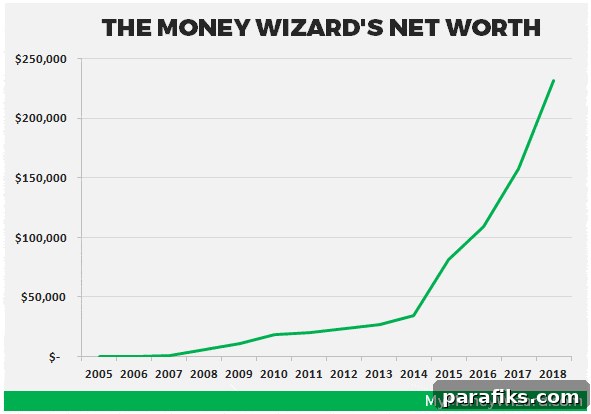
Numbers tell part of the story, but the real lesson lies in the simple, practical steps I used to accelerate my savings—steps anyone can adopt.
1. I learned the power of compounding.
In high school my math teacher posed a classic question: would you rather have $1,000,000 now, or a single penny that doubles every day for a month? Most classmates picked the million, but that penny would grow to about $5.4 million after 30 days.
Another example: two investors both want to be millionaires by 60 and both earn 7% annually. The first invests $10,000 a year from 24–40 and then stops, letting compounding carry her to a million. The second waits until age 40 and must invest more than $26,000 a year—plus for a longer period—to reach the same goal.
Compounding is hard to intuitively grasp, but its implication is clear: the best time to start investing is right now. I began investing in my late teens, even if amounts were small. Time multiplies whatever you put in.
2. I picked a degree that leads to good pay.
I graduated with degrees in Economics and Finance, which rank among higher-paying majors. While passion played a part, the choice was largely strategic—I researched starting salaries, reviewed job postings, sought mentors, and attended career fairs to maximize my chances for a well-paying start.
3. I avoided the starting-salary bait-and-switch.
After college I had multiple job offers. One came with a higher starting salary but limited upward mobility; the other offered a slightly lower start with clearer promotion paths. I took the latter—$50,000 to start—and five years later I was earning over $85,000, while the higher initial offer would have left me near $65,000.
Lesson: evaluate jobs over a longer timeframe, not just year-one pay. Consider five-year earnings or however long you expect to stay.
4. I embraced side hustles.
I graduated debt-free thanks to parental support, scholarships, and a willingness to hustle. In college I moonlighted as a mystery shopper, bought and sold concert tickets using student discounts, and flipped sporting equipment. Those efforts helped me avoid student loans and taught me a key lesson: anyone can monetize a skill or time to increase income.
Even small side incomes add up—find something that fits your schedule and skills.
5. I made saving automatic by reducing fixed expenses.
When picking my first apartment, I asked myself whether I’d rather splurge on trendy amenities or save on rent. I chose a less expensive place outside downtown and kept my older truck instead of taking on a car payment. These two choices saved me over $600 a month—more than $7,000 a year—which translated to roughly an extra 20% of my take-home pay saved each paycheck without drastic lifestyle sacrifice.
6. I tracked every expense.
To accelerate savings, I started reviewing my spending every month. I spent 30 minutes combing through statements and entering purchases into a spreadsheet. The exercise revealed surprising costs—adopting a dog, frequent dining out, and the odd impulse buy—and it motivated me to cut waste. Simply tracking spending makes you more aware, and awareness leads to better choices. Modern apps can make this even easier.
7. I used time more efficiently at work.
I’m not a workaholic, but I did focus on getting more done in less time to accelerate career growth. Many people lose hours to distractions; boosting efficiency can mean better performance, larger bonuses, and faster promotions.
Techniques I used:
- Create detailed to-do lists to stay accountable.
- Schedule the toughest, highest-impact task for the morning when I’m most productive—no email or interruptions.
- Use the Pomodoro Technique (25 minutes focused work, 5-minute breaks) to maintain sustained productivity.
- Prepare and negotiate confidently when asking for raises.
These changes helped my salary rise from $50,000 to over $85,000 within five years.
8. I stopped stock picking and embraced index funds.
At first I tried to pick winning stocks, thinking I could beat the market. For a while my picks rose in value, and I felt smart—until I compared my returns to a benchmark and realized the overall market had outperformed my portfolio. Over time that underperformance compounded into significant lost gains.
I learned that for most people—including my younger self—index fund investing is a far better strategy than trading individual stocks. By investing in broad market index funds, you accept market returns (historically around 7% annually) without the extra risk and time commitment of stock picking. That switch freed up time and often improved returns, creating more opportunities for side income and other productive pursuits.
The Money Wizard is a financial analyst by day and a money blogger by night. He saved over $200,000 by age 27 and aims to retire in fewer than ten years. If this story resonates, his free ebook outlines the rules he used to save aggressively and build wealth.