

What is micro-investing? Recently I’ve been hearing a lot about micro-investing, so I asked my sister-in-law and editor, Ariel Gardner, who has used micro-investing apps for over a year, to explain the topic.
I first encountered micro-investing a few years ago and immediately found it intriguing.
The basic idea is investing with very small amounts of money, designed to appeal to new investors who feel intimidated by traditional investing.
Perhaps you think you don’t have enough money to get started, or that investing is too complicated. Market volatility—regular ups and downs—can also be frightening for beginners.
Micro-investing aims to remove those barriers by making investing more accessible and less intimidating.
About a year after I learned about micro-investing, I experimented with a couple of apps, Stash and Acorns. Below I’ll share what I learned and highlight some of the most useful micro-investing apps available today.
A Beginner’s Guide to Micro-Investing
What is micro-investing?
Micro-investing simply means investing with small sums of money. Instead of buying full shares, your funds purchase fractional or micro shares of stocks or ETFs.
This is especially appealing to new or younger investors because cost is often a major barrier. For example, if one share of a stock costs $116.03, you’d normally need that full amount to buy a share. Through a micro-investing app, you can invest $5 in that same stock, gaining exposure even without full-share funds. If you do have more to invest, you can spread it across multiple assets to build diversification at a lower cost.
Many micro-investing platforms also act as robo-advisors. They ask about your age, income, target retirement, and goals, and then recommend an allocation to help you meet them. These apps typically distribute your dollars across multiple funds to keep a balanced approach, so you may end up owning pieces of dozens or even hundreds of companies without needing a financial planner.
How micro-investing apps work
Micro-investing is often called spare-change investing because many apps link to your bank card and round up purchases to the next dollar, investing the difference. For example, a $5.37 coffee purchase can be rounded to $6 and $0.63 set aside for investing. Some apps offer multipliers, such as 2x, 3x, 5x, or 10x, where a $0.63 round-up could become $3.15 with a 5x multiplier.
Apps typically include safeguards to avoid overdrafts, though they’re not infallible. You control round-ups and multipliers and can toggle them on and off. You can also set recurring deposits—sometimes as low as $5 per month—or make one-time transfers.
Depending on the app, deposited funds may be automatically allocated to investments that match your chosen portfolio. That’s the robo-advisor feature: accounts may be periodically rebalanced if you become overweight or underweight in certain asset classes. Other apps let you choose specific investments; in that case, funds may sit as uninvested cash until you buy micro-shares or set a purchase schedule.
What to expect from micro-investing
It stands to reason that small investments generate small returns, but micro-investing offers valuable learning opportunities. It lowers the barrier to entry so newcomers can experience market behavior firsthand without large financial risk.
One important lesson is market volatility—the frequent ups and downs of stock prices. Micro-investing exposes you to these movements on a smaller scale, helping you become more comfortable with the idea of staying invested through fluctuations.
You’ll also gain practical knowledge about asset allocation, tax-loss harvesting, differences between ETFs and mutual funds, and more. Micro-investing provides hands-on learning without requiring a major financial commitment.
The cost of micro-investing
Many traditional brokerages charge a percentage of assets under management, but most micro-investing apps use a fixed subscription fee—typically $1 to $9 per month depending on services. When your balance is small, a flat fee can represent a significant percentage of assets (for example, $1 on a $20 balance equals a 5% fee), which is an important trade-off to consider.
Some established brokerages now offer fractional-share options—examples include Schwab Stock Slices and Fidelity’s Stocks by the Slice—so fractional ownership is no longer exclusive to micro-investing apps. What micro-investing apps often provide beyond fractional shares is the spare-change model combined with automated, guided investing through a robo-advisor experience.
Four Recommended Micro-Investing Apps
Here are four popular micro-investing platforms worth considering:
- Acorns
- Stash
- Betterment
- Twine
Below is a brief overview of each app and what they offer.
1. Acorns
Founded in 2012, Acorns is one of the earliest micro-investing apps. It links to debit and credit cards and rounds up purchases, offering multipliers such as 2x, 3x, and 10x for round-ups. Acorns provides five portfolio options ranging from conservative to aggressive, built using Modern Portfolio Theory.
Acorns offers a fully automated experience: set up round-ups or scheduled transfers, and Acorns invests in micro-shares of ETFs that match your chosen portfolio. A “Found Money” feature allows you to earn investment credits when you shop with Acorns’ partner companies; those credits are deposited into your account after a delay.
Acorns pricing plans include:
- Lite – $1/month: Personal investment account
- Personal – $3/month: Investment account, tax-advantaged retirement account, and checking
- Family – $5/month: Includes custodial accounts for kids in addition to Personal features
I tested Acorns for about a year and, using round-ups and a $50/month automated transfer, saw my account grow to over $900. The experience was largely set-and-forget, though it’s important to remember that cashing out requires selling assets—potentially triggering taxes—and isn’t the same as an emergency savings account.
2. Stash
Founded in 2015, Stash offers flexible and educational investing for beginners. Unlike some fully automated platforms, Stash allows you to choose your investments and buy fractional shares of ETFs and stocks. Stash renames familiar ETFs to make them more accessible—for example, “Clean & Green” for an iShares clean energy fund—and offers themed options like Women Who Lead, American Innovators, and Combat Carbon.
Stash offers two primary plans:
- Growth – $3/month: Personal investment account, Roth or Traditional IRA, and access to Smart Portfolio
- Stash+ – $9/month: All Growth features, two custodial accounts for kids, Stock-Back® rewards, monthly market insights, and $10,000 of life insurance via Avibra
All Stash accounts also include banking features, including a Stock-Back® debit card that rewards purchases with fractional shares. Note that rewards and banking services may be subject to partner terms and availability.
3. Betterment
Betterment is a true robo-advisor: you select your savings or investing goal and Betterment creates a strategic portfolio for you. It offers a more traditional brokerage feel, with portfolio choices, pricing tied to assets under management, and optional financial advice packages.
Betterment charges 0.25% annually on investment and retirement accounts, dropping to 0.15% for accounts with $2 million or more. For investors with $100,000+, Betterment Premium is available for 0.40% and includes unlimited access to Certified Financial Planners (fee drops to 0.30% at $2 million).
Account types include personal and joint investment accounts, IRAs (Traditional, Roth, SEP), and rollovers for 401(k) and 403(b). Beyond conservative to aggressive portfolios, Betterment offers strategies like Socially Responsible Investing, Goldman Sachs Smart Beta, and BlackRock Target Income for income-focused investors nearing retirement.
Betterment funds accounts via recurring or one-time deposits—it doesn’t offer round-ups. It also provides financial planning packages starting around $199, which include a call with a Certified Financial Planner to create a personalized plan for life events such as marriage, retirement, or college savings.
4. Twine
Launched by John Hancock in 2017, Twine focuses on joint saving and investing for couples. It allows partners to save together toward shared goals—vacations, down payments, car purchases—and lets each person contribute different amounts. Twine’s cash savings option is FDIC-insured up to $250,000 and free to use. Investing costs $0.25 per month for every $500 invested.
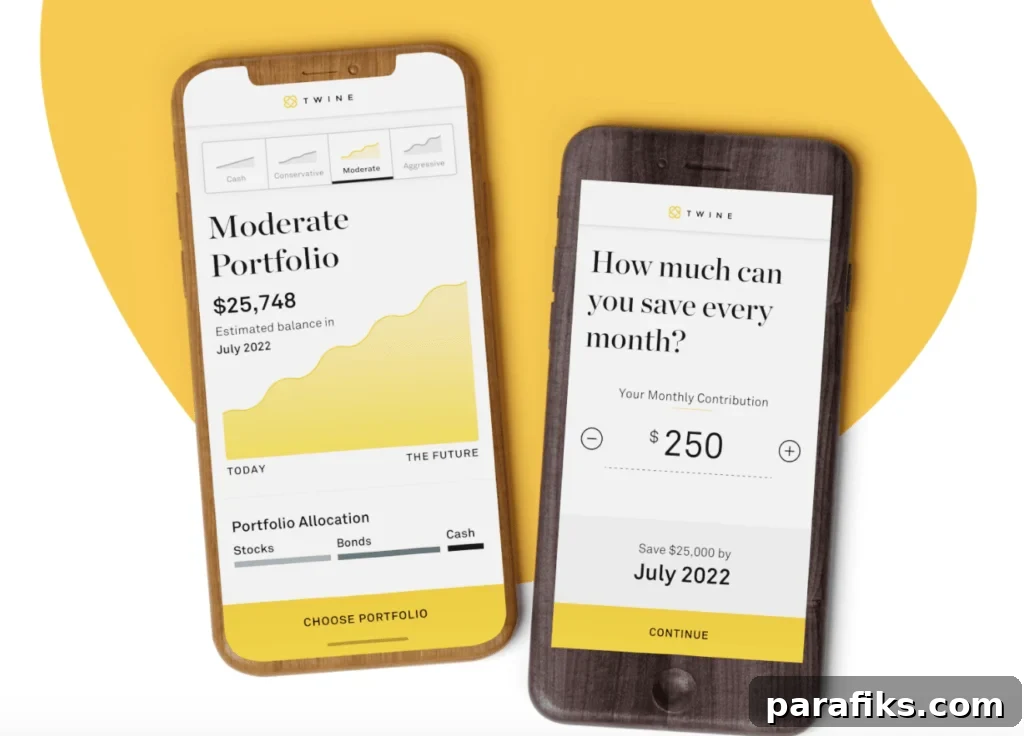
After creating an account and inviting a partner, you set a goal, a target amount, and a timeline. Twine asks about your finances and risk tolerance, then matches you to a conservative, moderate, or aggressive portfolio made up of ETFs and mutual funds. Contributions stay in separate individual brokerage accounts, so you only control the money you contributed.
Is micro-investing worth it?
I’m not a financial professional, but micro-investing helped me overcome my hesitation about investing and allowed me to learn how markets work without large commitments. These apps demonstrate that anyone can begin investing—even with as little as $5 per month.
The drawback is that spare-change investing alone isn’t usually a sufficient long-term strategy. I maintain micro-investing accounts with Stash and Acorns for hands-on learning, but I also use a larger brokerage for long-term planning and retirement investing. Micro-investing served as a springboard: it taught me about market behavior and increased my confidence to manage larger investment plans.
If you try a micro-investing app, treat it as an educational tool. Pay attention to fees, understand how the market works, and use these apps to build habits and knowledge that support broader financial goals.
Are you interested in trying any of these micro-investing apps? What appeals to you most about micro-investing?
Disclosures:
Paid non-client endorsements may appear. Nothing in this article is an offer or recommendation to buy or sell securities. All investments carry risk and may lose value.
Some product features, insurance, and rewards mentioned are subject to eligibility, terms, and availability. Fees, limitations, and qualifications vary by provider. Diversification and asset allocation do not guarantee profits or protect against loss of principal. Always review provider disclosures and terms before investing.