
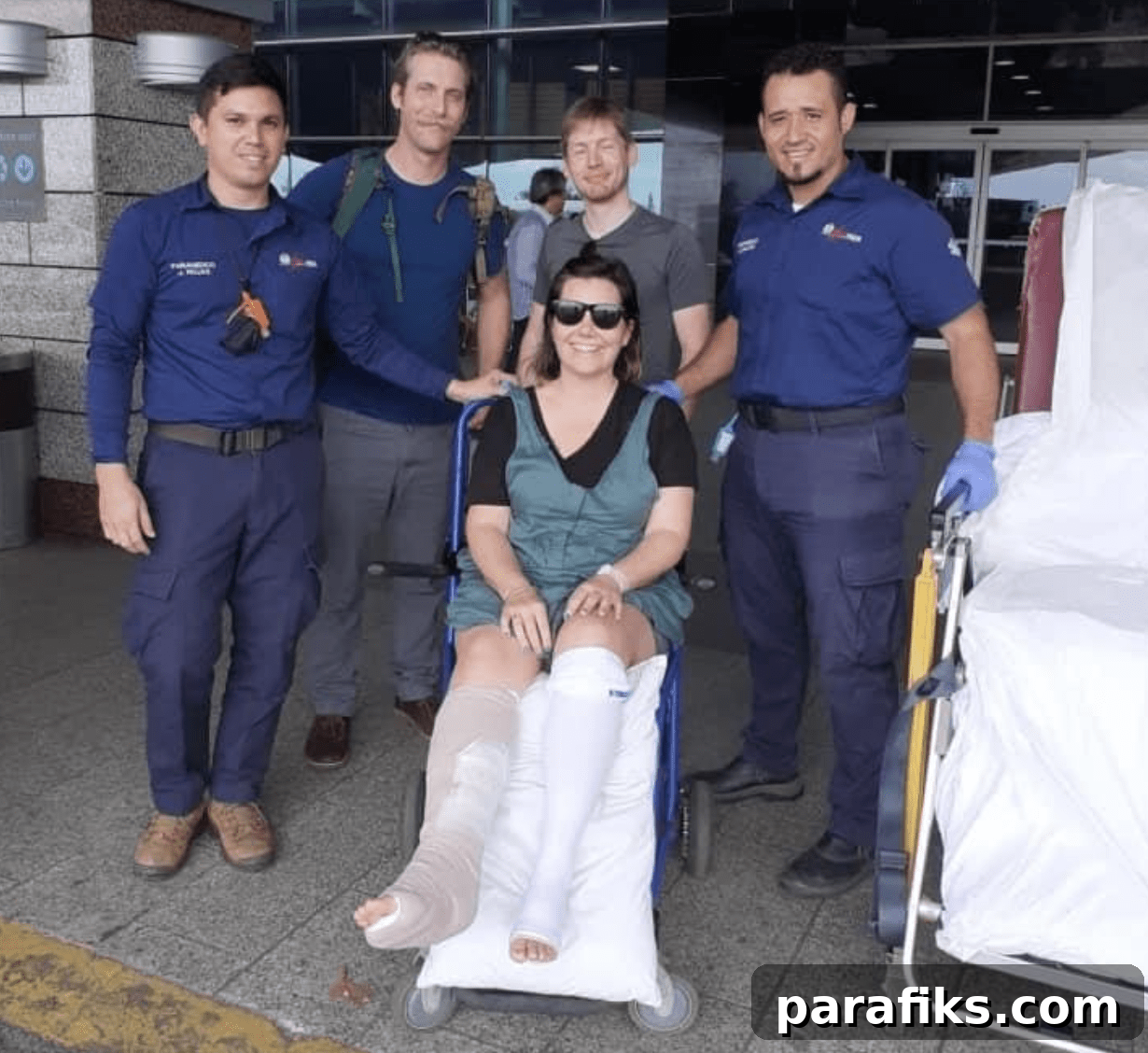
Today I’m sharing an in-depth travel insurance review written by my sister-in-law and editor, Ariel Gardner. She explains her personal experience with travel insurance after a medical emergency abroad and walks through the claims process. You may have seen Ariel here before writing about taking her side hustle full-time, living in a small house, real life frugality, and more.
Earlier this year I was enjoying a relaxing Caribbean cruise with one of my best friends. Every morning I had breakfast delivered to my room, sipped cocktails in the evening, and barely thought about the travel insurance policy I’d purchased “just in case.”
On day four we docked in Santo Domingo, Dominican Republic, and our group explored Fortaleza Ozama, a Spanish fort built in 1502. After walking up several flights of stairs to enjoy the view, I fell on the first step down and broke my leg.
The fall itself was not dramatic, but I twisted my leg in a way that resulted in a spiral fracture involving my ankle, tibia, and fibula. Chaos followed as we navigated whether to have surgery in the Dominican Republic, how to get my husband there, and how to return home—this all happened in early March 2020 as countries were shutting down due to COVID-19.

My travel insurance went from an afterthought to essential as I amassed over $10,000 in out-of-pocket medical bills and unexpected travel expenses in a matter of days. Eight months later my claims were finally resolved, and I had my last follow-up with the surgeon who repaired my leg with a metal rod and seven screws.
I learned a great deal about travel insurance during this ordeal, and my biggest takeaway is simple: I will always buy travel insurance when I travel outside the country. Below I explain what I learned and why travel insurance can matter so much.
Related content:
- How To Travel On A Budget And Still Have The Time Of Your Life
- How To Take A 10 Day Trip To Hawaii For $22.40
- Want To Be A Full-Time Traveler? 13 Ways To Make It Happen
My True Travel Insurance Review Story & Why You Should Consider Travel Insurance
The cost and details of my travel insurance plan
Travel insurance typically costs 5%–10% of the total trip price. The exact cost depends on coverage type, destination, trip length and price, and your age. I chose a policy from Generali Global Assistance because of their ratings and the coverage options they offered.
I paid $142.68 for Generali’s Preferred Plan. The policy limits included:
- Trip cancellation: 100% of trip cost
- Trip interruption: 150% of trip cost
- Travel delay: $1,000 per person
- Baggage loss: $1,500 per person
- Sporting equipment: $1,500 per person
- Sporting equipment delay: $300 per person
- Missed connection: $750 per person
- Medical & dental: $150,000 per person
- Emergency assistance & transportation: $500,000 per person
- Accidental death & dismemberment (air flight accident): $75,000 per person / $150,000 per plan
- Accidental death & dismemberment (travel accident): $25,000 per person / $50,000 per plan
I worried about cancellation and interruption coverage because I was traveling just as COVID-19 arrived in the U.S. My plan included “cancel for any reason” (CFAR) coverage as an option, which reimburses a portion of costs regardless of the reason but is more expensive. I also purchased higher medical coverage after remembering a story about a traveler whose esophagus ruptured on a cruise and who incurred over $1,000,000 in medical expenses that were covered by a premium policy.
What my travel insurance actually covered
My injury turned out to be an open fracture—my tibia broke through the skin—so it required immediate cleaning and antibiotics to prevent infection. We opted for care at a private clinic in the Dominican Republic. The clinic required an 80,000 Dominican Peso deposit (about $1,369 at the time).
I received IV antibiotics and pain medication, X-rays, an electrocardiogram, and a surgical procedure to clean the wound under anesthesia. The surgeon recommended a subsequent ORIF (open reduction internal fixation) procedure to insert a rod and screws, but we decided to have that done back in the U.S. with my regular surgeon. I stayed in the clinic for two days and received further IV antibiotics; after applying the deposit, the additional bill was 357,000 DOP (about $6,110).
Because my leg was not yet fully stabilized, I needed a travel companion to fly home. My husband booked a last-minute flight to the Dominican Republic ($400) and we arranged first-class one-way tickets home at the start of the pandemic—$1,275 each—so I would have space for my bandaged leg. An ambulance transfer to the airport cost 7,600 DOP (about $130). The total for those added travel and transport expenses was about $3,080.
Travel insurance reimbursed the following:
- $1,369 — deposit for the clinic
- $6,110 — surgery and hospital stay
- $2,550 — two first-class flights home
= $10,029 total reimbursed
Not everything was covered. Generali did not reimburse my husband’s $400 flight to the Dominican Republic because they said it was not part of emergency assistance and transportation; they considered that someone already in the Dominican Republic could have accompanied me. A $200 flight I had booked with points was also denied because Generali’s policy does not reimburse award travel. Finally, the $130 ambulance ride was denied because the receipt had no date. That left $730 in expenses we did not recover.
The cruise fare itself was handled separately: my friend, who was part of the cruise entertainment, had arrangements so the cruise organizer covered my guest ticket. If I had personally paid for the cruise, I would have submitted that portion to my travel insurance.
In short, my $142.68 policy saved me more than $10,000 in out-of-pocket expenses.
Will my health insurance cover medical costs when I travel?
Domestic health insurance rarely covers routine care outside the U.S., and if it does, it’s usually only for true emergencies. My insurer (Anthem Blue Cross Blue Shield) deemed my situation urgent but not an emergency by their definition, which affected the claims process.
Always call your health insurance provider before travel to understand their international policy, but be prepared that coverage will likely be limited.
What about the travel protections offered by my credit card?
Some premium travel credit cards include travel protections—baggage delay, trip delay, trip interruption, accidental death and dismemberment, and rental car collision coverage. To qualify you usually must book the trip with that card. However, credit card protections tend to be limited compared with standalone travel insurance. In my case, none of my travel cards would have covered the medical and evacuation costs that Generali covered.
Credit card protections can be useful for certain scenarios, but don’t assume they replace a third-party travel insurance policy for significant medical emergencies abroad.
What about flight insurance?
Airlines often offer add-on flight protection for a small fee during checkout. That coverage is limited: typically it does not include medical expenses, lost luggage beyond basic limits, or CFAR. Don’t rely on airline add-ons for comprehensive protection.
When should you buy travel insurance?
Given the limitations of domestic health insurance, credit cards, and airline offerings, I strongly recommend travel insurance for international trips. Key reasons to buy travel insurance include:
1. You’re concerned about medical expenses
Travel medical insurance is the primary reason to buy coverage. Medical emergencies abroad can be financially devastating. Policies vary on pre-existing condition coverage, so compare plans if that’s relevant to you.
2. You want coverage for baggage and personal belongings
Travel insurance can reimburse lost or damaged items (within policy limits and assuming reasonable care). High-value items such as wedding rings often have caps or exclusions, so check policy specifics and consider leaving valuables at home.
3. You’re an adventurous traveler
If your trip includes higher-risk activities—hiking, ziplining, surfing, caving—look for policies that cover adventure sports. Companies like World Nomads offer options for more extreme activities.
4. You want the option to cancel for any reason
CFAR policies give flexibility to cancel for non-covered reasons but are more expensive and often reimburse only 50%–75% of prepaid, nonrefundable costs. Research carefully before purchasing CFAR add-ons.
5. You might need to come home early
Travel insurance can reimburse unused trip costs and last-minute transportation if you need to return home due to a family emergency or other covered reason.
Ultimately, travel insurance provides peace of mind by protecting against unpredictable, costly scenarios.
Traveling with travel insurance
Before you leave, print and store a copy of your travel insurance policy and keep it accessible while you’re away. I didn’t have my policy on me when I needed it, and someone had to retrieve it from the cruise ship. It’s also wise to send a copy of your policy and itinerary to a trusted person at home so they can initiate claims if needed.
What to expect when you file a travel insurance claim
The claims process can be frustrating and slow. We resubmitted paperwork twice, had an initial denial because we hadn’t first submitted medical bills to my health insurer, and waited seven months for payment. Travel insurers are very specific about documentation and electronic submission requirements.
Key tips for filing claims:
- File your claim as soon as possible—most companies require submission within 90 days.
- Submit everything electronically and ensure photos/scans of receipts are clear.
- Submit medical claims to your primary health insurer first—travel insurers often require an official denial or explanation.
- Keep any documents related to your travel and emergency costs, even handwritten or imperfect receipts; small notes can matter.
- Expect long processing times—claims can take three months or longer.
Be patient and maintain regular contact with your claims agent for updates and reassurance.
Should you buy travel insurance?
Going forward, I will always buy travel insurance when traveling internationally. It’s an additional expense to budget for, but the protection it provides can prevent catastrophic financial loss. Being injured in a foreign country where I didn’t speak the language was terrifying; knowing most of my expenses would be covered helped me through those difficult days.
Travel insurance is a choice, but for me it’s a valuable one that brings peace of mind.
Do you usually buy travel insurance? Is there anything you’d like me to add to this travel insurance review?