
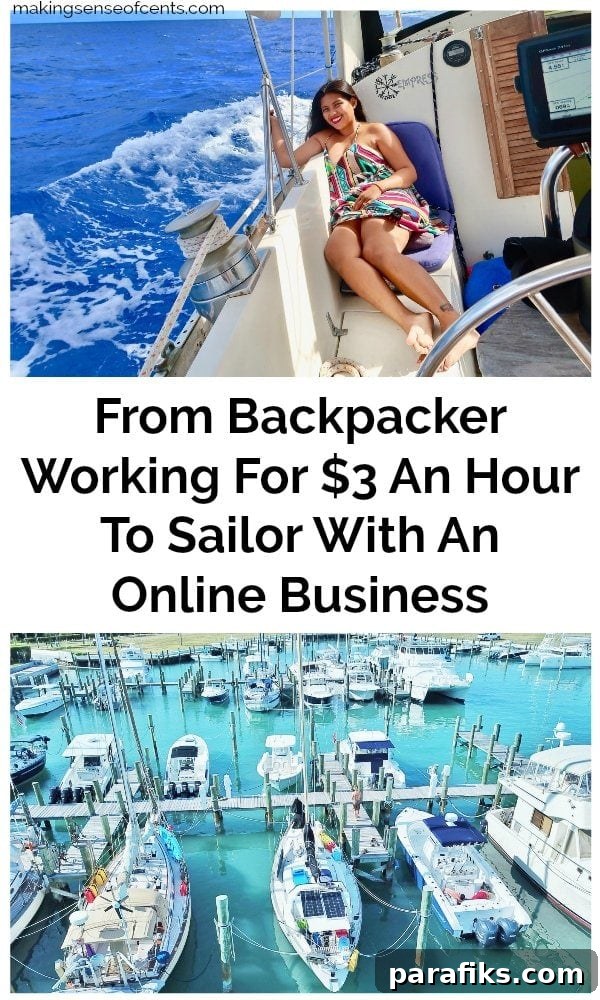
 My monthly “Extraordinary Lives” series is one of my favorite projects. Previously I featured JP Livingston, who retired at 28 with a net worth of over $2,000,000. Today’s interview profiles Kach Howe, a traveler who has visited more than 100 countries across all seven continents and now sails the Caribbean with her husband and their cat.
She isn’t retired—she still works while living a life at sea.
In this interview you’ll learn:
- How she has been traveling continuously for five years and has visited 100+ countries;
- Why and how she transitioned to living aboard a 1971 Finnrose 37 sailboat;
- How she and her husband funded their travels;
- How teaching English for as little as $3 an hour in Peru pushed them to create alternative income streams;
- What sailing expenses actually look like.
This conversation is packed with practical details and real-life examples. Her story has been featured by CNN, BBC, Yahoo Travel, Forbes, Cosmopolitan, and more.
I asked readers to suggest questions for this interview, so many of the items below come from your submissions. If you’d like to be part of future interviews, follow the author’s social pages to submit questions.
Tell me your story. Who are you and what do you do?
My name is Kach. Together with my husband, Jonathan, I’ve been traveling the world since May 2013. For the past five years we’ve supported ourselves through online businesses—primarily our travel site Two Monkeys Travel—while branching into lifestyle content, travel coaching, visa assistance and flight reservations via a second website.
I’m originally from the Philippines and moved to Kuwait after university to pursue a new career in the oil & gas industry. After three years I relocated to Erbil in Iraqi Kurdistan, seeking bigger opportunities and a more adventurous life. There I met many internationals and English teachers and was inspired by backpackers and hitchhikers whose nomadic freedom convinced me to start traveling.
A few weeks into backpacking Southeast Asia I met Jonathan, a British traveler who had left architecture in the UK to explore the world. We decided to travel together and have been doing so since 2013. We’ve visited more than 100 countries across seven continents, including Antarctica. In May 2017 we swapped land travel for life at sea, spending months refurbishing a 1971 Finnrose 37 sailboat, Empress, which is now our home. As of February 25, 2018, we began cruising the Caribbean and are currently in the Bahamas with our adopted kitten, Captain Ahab.
How many countries have you traveled to? Did you used to live out of a suitcase?
Each of us has visited over 100 countries across all seven continents; seventy of those were visited together. Since we started sailing, our pace of travel has slowed, but we continue to add new destinations as we cruise the Caribbean.
During the first two years we lived out of backpacks, occasionally booking short-term apartments to earn money and regroup. As Two Monkeys Travel grew, we began working with hotels, tours, airlines, brands and tourism boards. That change led us to swap backpacks for suitcases, upgrade our clothing and invest in better laptops and camera gear to meet client expectations.
How did you afford to travel that way?
When we first traveled together in July 2013 we taught English in Hanoi and saved over $10,000 in seven months. That funded travels around India, yoga and Ayurveda massage certification courses, a short trip to the Maldives, and a visit to family in the UK. We stretched funds by traveling frugally and volunteering in hostels for accommodation.
By July 2014 we were nearly broke in Peru and volunteered in an Ollantaytambo hostel, teaching yoga for donations and offering mobile massages to tourists using borrowed equipment. We then moved to Arequipa, rented a two-bedroom apartment for $600/month, converted the spare room into a massage therapy space, invested our remaining funds into a massage table and a small rice cooker, and built a regular client base. During this time we launched Two Monkeys Travel; within months media features from major outlets drove traffic and income through affiliates, brand partnerships and sponsored content, enabling us to stop teaching and earn our living online.
Can you tell me more about teaching English? Was that a full-time income? Can anyone do this?
In Hanoi, English teaching paid well compared to local costs—about $20 an hour—while in Peru our rate dropped to roughly $3 an hour, which made it difficult to cover living expenses. Requirements vary by country; in many places fluency and a TEFL certification are sufficient, while some employers prefer native English passport holders and may pay higher salaries. Teaching provided initial funds, but the low pay in some locations motivated us to diversify income and build our online business.
Why did you decide to start sailing?
Traveling constantly was exhilarating but exhausting: we explored by day and worked late into the night to maintain our business. After our wedding in August 2016 we wanted a stable place to call home. A sail from Panama to Cartagena through the San Blas Islands in 2015 planted the seed for a life at sea. In May 2017 we found Empress, a neglected boat in a Florida Keys boatyard, and decided to transform it into our floating home so we could continue traveling while having a consistent base.
Tell me more about your sailboat.
Empress is a 1971 Finnrose 37 sloop, built in Finland for rough northern waters. She’s 37 feet long with a 12-foot beam and a sturdy fiberglass hull designed for blue-water cruising. Because of her age and condition, we spent about $50,000 over eight months getting her seaworthy—repairs, rigging, electronics, interior refurbishment and safety gear. Jonathan handled the structural and mechanical work; he also modernized the interior with bright paint, new linings, a solar power system, fridge and freezer, updated navigation equipment, and a composting head. We also purchased a Viking liferaft and comprehensive marine insurance.
Do you plan on sailing around the world? What experience do you have sailing?
Jonathan completed an RYA Day Skipper course in September 2016 to learn boat handling basics, but neither of us had extensive sailing experience before buying Empress. We plan to cruise the Caribbean for at least a year, then transit the Panama Canal for a Pacific crossing. Empress is capable of ocean passages, and while she’s ideal for our current needs, we’re already considering a long-term upgrade to a NEEL 51 trimaran for greater comfort and performance before attempting a full circumnavigation.
How will you work and sail? What will you do for internet?
Staying connected while sailing is a familiar challenge for us. Much of cruising time is spent anchored near land, where local SIM cards or shore Wi-Fi are available. In the Caribbean we rarely make crossings longer than two days, so we schedule work around our sailing plans. Crucially, most of our business is delegated to a full-time remote team. I personally handle travel coaching, which requires about 15–20 hours per week. We supplement local connectivity with data plans when needed to run the business.
What’s an average day like for you?
No two days are the same. We wake with the sunrise; I feed our kitten and handle emails, coordinate with assistants, or meet coaching clients. I practice Hatha Yoga in the morning or at sunset. Jonathan enjoys a slow morning with coffee on deck before we tackle writing, campaigns or boat projects. If we’re ashore, we might spend time exploring; if we’re anchored, we work and maintain the boat. Today, for example, after finishing this interview we’ll join friends for a beach bonfire.
How much does sailing cost?
Costs fall into two categories: buying and preparing a boat, and ongoing sailing expenses. We spent more than $50,000 to prepare Empress for cruising, including parts, rigging, electronics and post-Hurricane Irma repairs. Ongoing sailing costs are much lower if you anchor most of the time, cook onboard and avoid marinas. Before leaving the Florida Keys we provisioned supplies and spare parts for about $5,000 and paid roughly $4,000 on safety gear, insurance and apps.
From February 26 to March 29 in the Bahamas, our expenses while mostly at anchor totaled $1,490.65, including permits, fuel, internet, groceries, minor parts and meals ashore. Marina fees during that period added $1,029.53, bringing the 35-day total to $2,520.18. Many of these purchases were one-time or infrequent items (filters, zincs, propane, provisioning), so monthly costs tend to fall once a boat is fully stocked and systems are settled. Our internet usage is higher than average due to running a business; friends often use around 15 GB per month here, while we used 50 GB in just a few weeks.
Costs vary widely depending on lifestyle, provisioning choices and how often you use marinas versus anchoring, but this breakdown provides a realistic snapshot of early cruising expenses.
Note: business expenses are not included in these totals.
How do you handle health insurance and health care?
We don’t carry traditional medical or life insurance. Instead, we rely on comprehensive travel insurance that covers medical emergencies, evacuation and common travel mishaps like missed flights or theft. We don’t schedule routine checkups abroad; we stay healthy through lifestyle choices and understand the available emergency services at our current locations. Travel insurance gives us coverage for urgent needs and repatriation if necessary.
Do you think you’ll ever live in a more traditional home in the future?
We’ve considered settling on land someday—buying property in Greece has crossed our minds—but right now that feels too limiting. Anchoring our capital in land and a fixed home is less appealing than investing in a more comfortable, mobile boat. For now, we prefer the freedom and mobility of the cruising lifestyle and aim to upgrade to a larger multihull in the future.
What’s one place you can’t wait to visit on your sailboat?
San Blas holds special meaning: Jonathan proposed to me on a tiny island there during a trip from Panama to Cartagena. One of our goals with Empress is to return to the San Blas Islands by boat and relive that memory together.
What’s your best advice for someone who wants to achieve the same success?
Belief in yourself matters, but the practical edge comes from continuously learning and building a diverse skill set you can use anywhere. Put yourself in challenging situations—those moments force creativity and growth. Start trying things even before you feel fully ready; action often produces the ideas and resilience you need. Above all, be persistent: dreams really can come true.
What questions do you have for Kach? Are you interested in living a nomadic life?